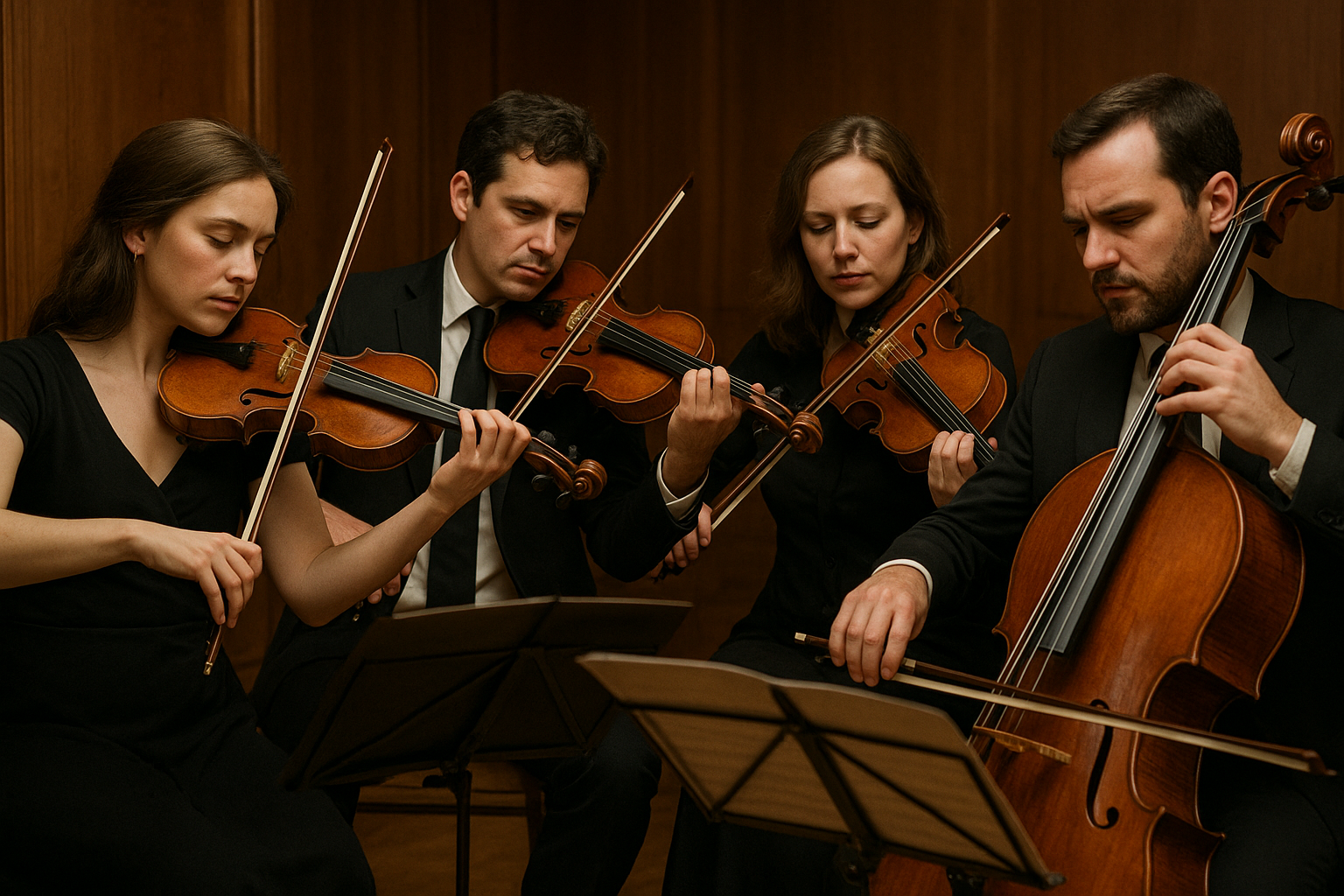
Music has always been a profound reflection of human emotion and intellect. Among the many styles of musical composition, the string quartet stands out for its intricate interplay of voices. The quartet not only provides a rich tapestry of sound but also challenges both performers and listeners to appreciate the complexity of musical texture and counterpoint.
The Structure of a Quartet
A standard string quartet includes two violins, a viola, and a cello. This setup provides a unique opportunity to explore counterpoint—the art of combining distinct melodies in a harmonious manner—and texture, which refers to how these melodies interact to create a complete sound.
- Melody: The core sequence of notes that provides the primary musical line.
- Harmony: The combination of different musical notes played or sung simultaneously.
- Counterpoint: Multiple independent melodies played together.
- Texture: The overall quality and feel of the music, informed by melody, harmony, and rhythm.
Exploring Counterpoint
Counterpoint in a quartet allows each instrument to assert its unique voice within the ensemble. Johann Sebastian Bach, the master of counterpoint, once said, “Music is an agreeable harmony for the honor of God and the permissible delights of the soul.” His words encapsulate the idea that counterpoint is not merely a technical exercise but a form of spiritual and emotional expression.
“Counterpoint often creates a tapestry where each voice is indispensable, contributing to the overall narrative.”
— BBC Music
The Role of Texture
Texture in a string quartet can vary from a homophonic setting, where one voice carries the primary melody with accompaniment, to polyphonic textures where multiple lines intertwine equally. This variation is crucial in evoking different emotions and responses.
Homophonic Texture
When composers use a homophonic structure, the melody is supported by harmony, making it more straightforward but still powerful. This was often favored in the Classical period, as seen in the works of Franz Joseph Haydn, known as the “father of the string quartet.”
Polyphonic Texture
Polyphonic texture, however, involves weaving multiple independent lines, akin to a musical dialogue. Composers like Ludwig van Beethoven and Wolfgang Amadeus Mozart exploited this style, creating complex emotional landscapes and interwoven narratives.
Beethoven’s late string quartets, for instance, demonstrate extraordinary polyphonic textures, pushing the boundaries of the form and challenging the conventions of the time.
Interplay Between Instruments
Beyond textures and counterpoint, the intimacy of a string quartet lies in the distinct roles each instrument plays. The first violin often carries the melody, with the second violin providing harmonious support. The viola adds depth and warmth, while the cello anchors the music with a robust, resonant foundation.
“The true art of quartet playing is when each musician must listen intently, adjusting their own contribution to blend and support the group as a whole.”
— The Guardian
The Emotional Journey
Analyzing the texture and counterpoint in a quartet offers insights into the complexity of human emotion. Each piece can take the listener on a journey through joy, sorrow, conflict, and resolution. For performers, it’s a dynamic process of collaboration and balance, requiring acute awareness and mutual respect.
As the listener, engaging with a string quartet becomes a personal exploration. The interaction of voices allows for moments of introspection and revelation, as one becomes attuned to the subtleties of musical dialogue.
Conclusion: The Lasting Impact
The string quartet remains a testament to the power of artistic collaboration, a wellspring of innovation and expression. Its emphasis on texture and counterpoint ensures it will continue to captivate and challenge musicians and audiences alike for generations. Whether in a cozy concert hall or an expansive recording, the beloved quartet continually invites us into its intricate conversation.
As we immerse ourselves in the world of string quartets, we embrace the beauty of musical plurality—a harmonious reminder of our own capacity for creative expression and connection.