Author: editor

  • The Human and the Holy: Mozart\’s Quest for Balance in Music

    The Human and the Holy: Mozart\’s Quest for Balance in Music

    The Human and the Holy: Mozart’s Quest for Balance in Music

    Wolfgang Amadeus Mozart, a towering figure in classical music, crafted compositions that continue to resonate centuries after his death. His quest for balance between the human and the holy pervades his body of work, offering listeners a journey through divine inspiration tethered by profound emotion and human experience.

    Human Emotion in Melody

    Mozart’s genius lay in his ability to infuse a sense of humanity into music that could otherwise seem ethereal. His operas, such as The Marriage of Figaro and Don Giovanni, are vivid depictions of human life, brimming with imperfection and passion. Mozart deftly uses melody and harmony to convey complex emotions, capturing “the heart’s most hidden secrets without uttering a word,” as Albert Einstein noted in his reflections on music.

    The Holy Through Harmony

    While Mozart’s music is firmly rooted in human emotion, it also frequently reaches for the divine. His Requiem in D minor, composed during the last year of his life, embodies this balance. It is both a deeply personal piece and a transcendent exploration of the sacred.

    “The music is not in the notes but in the silence between,” Mozart is often quoted as saying. This understanding of music as a vessel for the divine is what grants Mozart’s compositions an otherworldly quality.

    A Synthesis of Worlds

    Mozart’s ability to navigate between these two planes—human and holy—enabled him to reinvent the boundaries of his art. Works like his Great Mass in C minor highlight this duality, weaving together liturgical reverence with intricate counterpoint that reflects human struggle and triumph.

    The synthesis of earthly concerns with spiritual quests reflected Mozart’s own life—filled with the joys of family and friends, yet punctuated by financial struggles and personal sorrows. This duality emerges vividly in his music, inviting audiences to explore their humanity within the context of the divine.

    Legacy of Balance

    Mozart’s enduring legacy speaks to his singular ability to balance these contrasting forces. As the acclaimed musicologist Neal Zaslaw has observed, Mozart’s works “achieve a synthesis and balance between the sacred and the secular” that continue to captivate and inspire.

    In an era that often separated the realms of the sacred from the profane, Mozart’s compositions remain a testament to the power of music to unite these domains, offering a timeless exploration of both the depths of the human soul and the heights of the divine.

    For further reading on the life and works of Mozart, consider visiting the Mozarteum Foundation.

  • A Mirror to the Infinite: Romantic Composers and the Sublime

    A Mirror to the Infinite: Romantic Composers and the Sublime

    The Romantic era, which spanned from approximately 1800 to 1850, was a time of great transformation and expression in art, literature, and music. One of the defining characteristics of this period was the exploration of the sublime—an aesthetic ideal that sought to evoke intense emotions and a sense of awe, often by reflecting the immensity of nature or the complexity of the human spirit.

    The Sublime in Romantic Music

    Romantic composers, such as Ludwig van Beethoven, Franz Schubert, and Hector Berlioz, harnessed music’s ability to evoke the sublime, encapsulating both the beauty and terror of existence. Music became a powerful means to mirror the infinite and convey emotions that words struggled to express. Beethoven, in particular, transformed the symphony into a vehicle of deep philosophical reflection.

    “The Romantic notion of infinity seems to be expressed in the ceaseless energy and complex formal construction of his music.”

    Beethoven’s Ninth Symphony, especially the choral final movement, titled “Ode to Joy,” exemplifies his effort to address universal brotherhood and the human quest for transcendence.

    Nature as a Source of Inspiration

    Romantic composers found inspiration in the natural world, translating its grandeur and mystery into music. Franz Schubert’s compositions often evoke the pastoral and evoke imagery of wide landscapes. His song cycle Winterreise paints a poignant, chilling picture of a desolate, winter journey.

    Similarly, Frédéric Chopin drew from nature’s beauty, though his approach was often more intimate and infused with personal emotion. His Nocturnes and Preludes capture fleeting moments, blending delicate melodies with profound emotional depth.

    Beyond the Immediate

    The Romantic era’s engagement with the sublime was not solely confined to the esoteric. It often intertwined with the sociopolitical landscapes of the time. Hector Berlioz’s Symphonie Fantastique exemplifies this synthesis by combining autobiographical elements with viscerally dramatic music. The symphony portrays an artist’s opium-induced visions, rich in thematic innovation and orchestral color.

    Liszt, too, embarked on a journey to capture the spiritual through music. His symphonic poems, like Les Préludes, challenge the listener’s perceptions and invite them to ponder existential questions.

    Conclusion

    Romantic composers’ exploration of the sublime set the stage for future musical innovations, reflecting and shaping the human experience. Their works continue to reverberate, inviting listeners to engage with the infinite complexities that lie within and beyond the music itself.

    For more on Romantic composers, visit Britannica: Romanticism.

  • The Resonance of Belief: How Faith Shaped Musical Structures

    The Resonance of Belief: How Faith Shaped Musical Structures

    Music and religion have been intertwined throughout history, with each shaping and influencing the other. Not merely as a backdrop to ritualistic practices, music in various forms of faith has evolved to be a conduit for spiritual expression and a structured pathway for worship and contemplation.

    An Ancient Symphony of Spirit

    In many ancient cultures, music was regarded as a divine gift. For example, in Greek mythology, Orpheus’ lyre could enchant all living things and even inanimate objects. The religious rituals of ancient Greece often employed music as an essential component. According to Smithsonian Folkways, “music in ancient Greece was almost always linked to the divine” (source).

    The Medieval Church: Crafting the Canon

    The Christian Church during the medieval period became a powerful patron of music. This era witnessed the rise of the Gregorian chant, a form of plainchant instrumental in formal worship. The chants, named after Pope Gregory I, were influential in standardizing a unified liturgical practice across Christendom.

    “The Gregorian chant exemplifies the perfect union between text and music, designed to enhance the spiritual messages of the church” – Musicologist Joan Gerard

    Moreover, the architectural grandeur of Gothic cathedrals is often credited with encouraging the development of polyphonic music. Inside these vast spaces, the acoustics amplified sounds, allowing for the intricate interweaving of voices—each independent yet harmoniously united.

    Eastern Spirituality: Rhythm and Reflection

    In Eastern traditions such as Hinduism and Buddhism, music plays a vital role in spiritual life. The ethereal sounds of the veena or sitar in Indian spirituality are associated with the goddess Saraswati and Shiva, respectively. Music’s rhythm and melody support meditation, helping practitioners focus and find inner peace.

    In Buddhism, the chanting of mantras with specific tonal inflections aims to bring practitioners into a deeper meditative state. As noted in a study by Pew Research, these chants are believed to resonate with the universe, manifesting harmony within one’s self and the surroundings.

    Islamic Influence: Maqam and Mysticism

    Islamic devotional music demonstrates the complexity and beauty of spiritual expression in forms like the na’at and nasheed. These vocal compositions often praise the Prophet Muhammad and convey a rich poetic tradition rooted in passion and reverence.

    The rich musical system of maqam provides structured melodic patterns that express different emotional states. This modality forms the bedrock of much traditional Arab music and is crucial in promoting the spiritual ethos during religious festivals and gatherings.

    “In the Islamic tradition, music serves as an auditory path to contemplation, where the soul elevates in atunement with the divine” – Scholar Tariq al-Jamil

    Modern Interpretations and Ecumenical Echoes

    Even in modern times, religious music continues to evolve. Gospel music in the African American tradition merges the emotional experience of faith with a cultural history of struggle and overcoming. As noted by The Library of Congress, “Gospel music has enriched American culture with its spirited hymns and the powerful message of hope” (source).

    Similarly, contemporary Christian music blends pop and rock elements with evangelical themes, often aiming to reach younger audiences and rejuvenate community engagement in spiritual life. These compositions bridge the sacred and the secular, maintaining the core values of religious beliefs while embracing modernity.

    Universal Harmony through Melody

    The intersection of faith and music highlights a universal truth: the quest for transcendence. Across different religions and traditions, this pursuit resonates in harmonious expressions meant to elevate the soul and nurture the spirit.

    As we continue to explore how these vibrant art forms influence and enrich each other, we are reminded that music, like faith, transcends the earthly domain, echoing a larger cosmic order that binds humanity in its melodic embrace.

  • From Manuscript to Miracle: The Devotional Act of Composing

    From Manuscript to Miracle: The Devotional Act of Composing

    The process of composition is often akin to a spiritual journey, one that transforms the solitary act of writing into a collective experience of miracle and marvel. Paganini once observed, “I am a composer, the most arbitrary creature one can imagine—a mere machine, tossed in the wind between inspiration and discipline.”

    The Solitude of Creation

    At its core, composing is a deeply personal and solitary act. It begins with a single concept, birthed from the recesses of the mind, that steadily grows into a full-fledged creation. This process is as much an act of dedication as it is of inspiration. Consider how authors retreat into solitude, much like Emily Dickinson, who penned many of her poems in isolation yet remained a towering figure in American poetry.

    • Finding Inspiration: An idea, a fleeting image, or a stray note can ignite the creative spark.
    • Overcoming Solitude: Writers such as Jack London believed solitude amplified focus, propelling their primary ideas into expansive universes.

    The Art of Discipline

    James Clear, an author on habits and productivity, notes, “Professionals stick to the schedule; amateurs let life get in the way.” This creates the dichotomy between the disciplined regularity of writing and the unpredictable bursts of inspiration that characterize the artist’s life.

    To maintain their momentum, successful composers practice stringent self-discipline:

    “You can’t wait for inspiration; you have to go after it with a club.” – Jack London

    • Setting a Routine: Many revered composers, like Ludwig van Beethoven, adhered to precise routines, recognizing the value of regular work habits in enhancing creativity.
    • Balancing Life and Art: Haruki Murakami, for example, famously maintained a strict daily regimen of writing, exercise, and rest to fuel his prolific output.

    Composing as Devotion

    Beyond the physical act of writing lies the spiritual essence of composition. Intertwined with devotion comes an exploration of emotions, human experience, and the quest for understanding the world through words. Walt Whitman, with his transcendentalist views, often imbued his poetry with themes of spiritual awakening:

    “For every atom belonging to me as good belongs to you.” – Walt Whitman

    This sense of shared experience achieves its pinnacle when the creation becomes a conduit for emotion and connection:

    • Shared Experiences: The composer’s journey resonates with audiences when their words create resonance, transcending personal boundaries.
    • Exploration of Human Truths: Leo Tolstoy asserted that art’s purpose is to express specific feelings so uniquely they become personal for each viewer or reader.

    From Manuscript to Miracle

    The transformation from a manuscript into a miracle happens when a work steps beyond its creator’s shadow to touch the lives of others. When we contemplate this transition from the personal to the collective miracle, we see composition as not just an art but almost a rite, a devotional practice. As Anne Lamott eloquently writes in Bird by Bird,

    “You can either set brick as fast as you can to get up a wall, or you can take one brick at a time and set it perfectly, creating a flawless wall.”

    The Impact of the Composed Word

    The resilience of a composer’s message often lies in its capacity to invoke change and dialogue. An effective composition stimulates thought and fosters community, bridging the gap between the creator’s solitary endeavor and the world at large. It is in this shared miracle that the true spirit of devotion lives on, where every word crafted becomes an eternal echo in the continuum of human expression.

    In conclusion, the act of composing stands as one of the most profound devotional acts, blending inspiration with discipline. It humbly begins with an isolated manuscript and transforms into a miracle of connectivity and expression. Just as Virginia Woolf asserted, “A good essay must have this permanent quality about it; it must draw its curtain round us, but it must be a curtain that shuts us in, not out.” Truly, in every composition lies a world waiting to be explored.

  • A Higher Purpose: The Commissioning of Sacred Music

    A Higher Purpose: The Commissioning of Sacred Music

    For centuries, sacred music has served as the soulful expression of humanity’s deepest spiritual yearnings, creating a divine bridge between the temporal and the eternal. Commissioning sacred music has become an act of both faith and artistry, fostering a profound connection that resonates through hallowed spaces.

    The tradition of commissioning sacred music can be traced back to the medieval period, where it found its initial home in the liturgical settings of the Christian church. Great composers, from Johann Sebastian Bach to Arvo Pärt, have been tasked with crafting music that transcends earthly concerns and elevates the spiritual experience.

    The Historical Significance

    • Patronage of the Arts: Historically, the commissioning of sacred music often came from the church itself or wealthy patrons who sought to enhance worship through the beauty of sound. Their contributions allowed composers to create works that glorified the divine.
    • Cultural Impact: Many sacred compositions became integral components of religious ceremonies. For example, Bach’s Mass in B minor is considered a monumental work that enriches both musical and spiritual landscapes.
    • Innovation and Tradition: Over time, the commissioning of sacred music has evolved, balancing the reverence of tradition with contemporary interpretations and innovations. This evolution keeps the art form vibrant and relevant.

    Contemporary Applications

    Today, the commissioning of sacred music continues to thrive, offering composers an opportunity to explore new dimensions of sound and spirituality. Notably, the modern composer Arvo Pärt has gained acclaim for his minimalist approach that captures the essence of sacred themes through what is often referred to as a “holy minimalism.”

    “The human voice is the most perfect instrument of all,” says Pärt, highlighting the intrinsic connection between music and the human experience.

    The Role of Technology

    The digital age has introduced new ways to commission and disseminate sacred music. Virtual platforms and streaming services allow compositions to reach global audiences, transcending borders and cultures. Online commissioning platforms now connect composers with congregations, ensuring that the creation of sacred music remains a vital part of religious and cultural expression.

    In conclusion, the commissioning of sacred music serves a higher purpose that extends beyond mere artistic endeavor. It symbolizes a profound dialogue between humanity and the divine, a sacred art form that continues to inspire and uplift the human spirit. As we navigate an increasingly complex world, these celestial sounds remind us of the enduring power of faith and creativity.

  • Finding Inner Peace: Classical Music for Mindfulness and Reflection

    Finding Inner Peace: Classical Music for Mindfulness and Reflection

    In a world where constant noise and distractions prevail, finding moments of tranquility can be challenging. Thankfully, classical music offers a profound way to enhance mindfulness and introspection, providing an oasis of calm that can lead to inner peace.

    The Power of Classical Music

    Classical music has been cherished for centuries not only for its artistic and emotional power, but also for its ability to influence the mind and soul. According to research published by Neuroscience News, listening to music can promote brain plasticity and improve mental health, enhancing relaxation and focus.

    “Music can heal the wounds that medicine cannot touch,” said renowned musician and conductor Yehudi Menuhin.

    Pieces to Elevate Your Mindful Practice

    Whether you are new to mindfulness or already incorporating it into your daily routine, the following classical pieces are excellent choices to guide you towards reflection and calm:

    • Clair de Lune by Claude Debussy. This timeless masterpiece captures the serenity of moonlight, inviting listeners to abide in a gentle, reflective state of mind.
    • Adagio for Strings by Samuel Barber. Often described as the saddest piece ever written, its profound emotional depth can assist in unclogging mental hoodoo, making space for peace.
    • Symphony No. 6 (Pathétique) by Tchaikovsky. This symphony delves deeply into the human condition, articulating a tapestry of emotions that lead listeners to a place of inner understanding and peace.
    • Goldberg Variations by Johann Sebastian Bach. These variations are renowned for their meditative quality, inviting a sense of calm and profound focus.

    Incorporating Music into Mindfulness Practice

    Integrating classical music into your mindfulness routine can be seamless and deeply rewarding. Here are a few suggestions on how to make the most of this practice:

    • Dedicated Time: Set aside a specific time each day for listening, free from interruptions and distractions.
    • Ambient Environment: Create a comforting environment, perhaps by dimming lights or lighting a candle, to enhance your sensory experience.
    • Active Listening: Focus on the different elements of the music—the melody, harmony, and rhythm—to anchor your mindfulness practice.

    By taking the time to intentionally listen to classical music, you open the door to a unique and reflective mindfulness journey.

  • The Geometry of Sound: Classical Forms and Universal Order

    The Geometry of Sound: Classical Forms and Universal Order

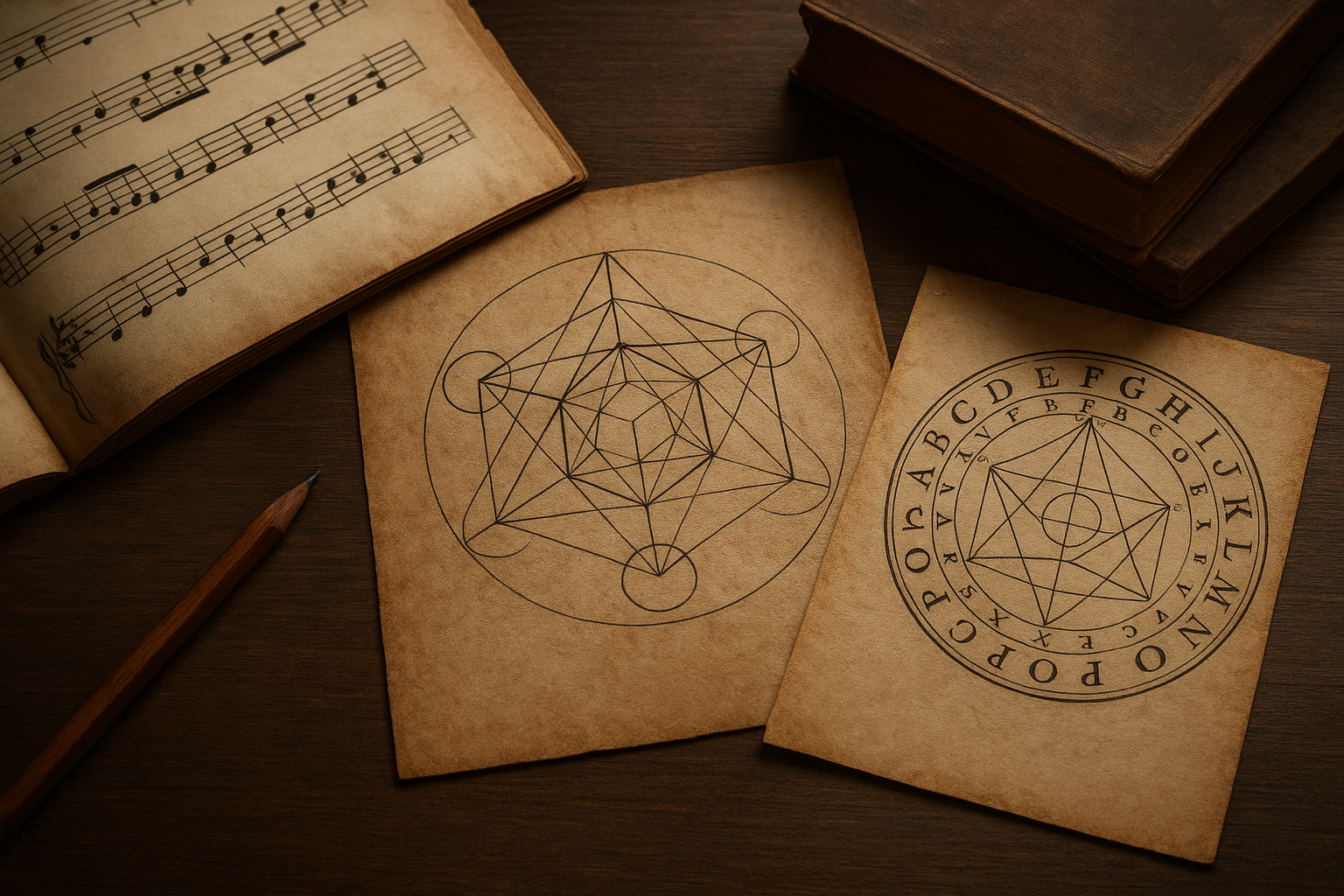
    The connection between geometry and sound has fascinated philosophers, mathematicians, and musicians for centuries. From the harmonious proportions of classical architecture to the intricate patterns of mathematical equations in modern acoustics, the pursuit of understanding sound through geometric principles represents a quest for universal order.

    The Ancient Roots of Geometric Sound

    In ancient Greece, thinkers like Pythagoras explored the relationship between numbers and music. He discovered what is now known as the “Pythagorean tuning,” a method that relates musical intervals to mathematical ratios. These ratios were believed to reflect the cosmic order, as summarized in the saying attributed to Pythagoras: “There is geometry in the humming of the strings, there is music in the spacing of the spheres.”

    “The harmony of the world is made manifest in Form and Number, and the heart and soul and all the poetry of Natural Philosophy are embodied in the concept of mathematical beauty.” — Sir D’Arcy Wentworth Thompson

    The Patterned Beauty of Classical Forms

    The use of geometry in music is not just a matter of aesthetic metaphor but a functional necessity. Classical musical forms, such as the sonata and symphony, often embody geometric principles. Symmetrical structures, such as the ABA form, create balance and coherence analogous to the symmetry found in architectural masterpieces.

    • Sonata Form: This widely used form includes three main sections: exposition, development, and recapitulation, mirroring geometric progression.
    • Fugal Structures: These employ intricate interweaving of thematic material, akin to the patterns found in fractals.
    • Golden Ratio in Music: Some composers have utilized the golden ratio to achieve pleasing mathematical balance, similar to visual art and architecture.

    Modern Interpretations and Universal Order

    Contemporary researchers are exploring sound through the lens of geometry to understand more profound patterns in nature. For example, the Chladni figures, patterns formed by sound waves on vibrating plates, are visual manifestations of this relationship. These patterns reveal hidden symmetries and resonate with the aesthetic beauty described by past thinkers.

    Chladni plates, named after musician and physicist Ernst Chladni, provide a fascinating glimpse into the ordered world of sound geometry. They demonstrate how sound waves can create distinct geometric shapes, leading many to speculate about the inherent structure of music itself.

    The search for the geometry of sound is part of humanity’s broader quest to uncover the universal order. As both a mathematical and artistic endeavor, it bridges disciplines and centuries, creating a harmonious reflection of our world.

  • Listening for Grace: Finding Redemption in Operatic Masterpieces

    Listening for Grace: Finding Redemption in Operatic Masterpieces

    Opera, a sublime synergy of music, libretto, and dramatic narrative, has long served as a medium for exploring the depths of human emotion and the possibility of redemption. Across compositions from different eras and cultures, operatic stories often revolve around characters seeking atonement, forgiveness, and grace. In this article, we examine some iconic operas where the theme of redemption is woven into the fabric of their music and storytelling.

    The Power of Redemption in ‘La Traviata’

    One of the quintessential operas that explores the theme of redemption is Giuseppe Verdi’s La Traviata. The story follows Violetta Valéry, a Parisian courtesan who finds love and yearns for a life of respectability and redemption. Her journey is a moving testament to personal transformation and sacrifice. Verdi’s music beautifully underscores Violetta’s struggle between her past and her longing for a redemptive future.

    “Violetta’s story is a poignant reflection on the power of love to bring about change and redemption.” – Metropolitan Opera

    In the famous aria “Sempre libera”, Violetta initially revels in her life of freedom, but this emotional high contrasts sharply with the tender love she experiences with Alfredo. This conflict ultimately leads her towards self-discovery and a tragic yet redemptive end.

    The Redemptive Arc in Wagner’s ‘The Flying Dutchman’

    Richard Wagner’s The Flying Dutchman is another masterpiece that delves into the theme of redemption. The opera tells the tale of a cursed sea captain doomed to sail the oceans forever unless he can find true love. Senta, a young woman, becomes the vessel of his hope for salvation. Her unwavering love and self-sacrifice provide the Dutchman with the redemption he desperately seeks.

    This opera explores the transformative power of unconditional love. Wagner’s music amplifies the tensions and eventual release experienced by the characters, creating an atmosphere rich with hope and redemption.

    “Wagner portrays redemption not just as an end goal but as an ongoing journey of love and sacrifice.” – Encyclopaedia Britannica

    Redemption’s Soliloquy in Mozart’s ‘Don Giovanni’

    Kvobargue Wolfgang Amadeus Mozart’s Don Giovanni presents redemption as a fleeting yet potent theme within its darker narrative. The opera follows Don Giovanni, a debauched nobleman whose unrepentant life of sin demands accountability. Throughout this masterpiece, characters suffer and seek their redemption against Giovanni’s recklessness. In the heart-stopping Commendatore Scene, the unrepentant Don Giovanni is ultimately confronted by the specter of his immorality, a reminder that redemption is a choice as much as a possibility.

    Redemptive Sacrifice in Puccini’s ‘Tosca’

    Giacomo Puccini’s Tosca is celebrated not only for its musical brilliance but also for its exploration of themes such as loyalty, love, and redemption. Floria Tosca, the opera singer at the heart of the tale, navigates a treacherous path to save her beloved Cavaradossi from execution.

    Her ultimate sacrifice embodies the redemptive quality of love, as she strives to secure a future for the man she loves, even at great personal cost. The juxtaposition of Tosca’s passionate arias with her tragic end serves as a testament to her character’s depth and the opera’s exploration of redemption through personal sacrifice.

    The Universality of Redemption in Opera

    From Violetta’s poignant sacrifice in La Traviata to Senta’s undying devotion in The Flying Dutchman, operatic masterpieces present redemption as a universal theme that transcends the stories of individual characters. These operas remind audiences that grace, forgiveness, and transformation are integral parts of the human experience.

    The timeless narratives of redemption offered by opera invite reflection on the choices we face and the paths we choose. As Richard Wagner poignantly stated,

    “Imagination creates reality.” – Richard Wagner

    Opera, in capturing the complexities of redemption, crafts a reality that resonates deeply with audiences, offering a space for contemplation and emotional engagement. Through its rich tapestry of music and drama, opera remains a powerful medium for understanding and experiencing the transformative power of grace.

    In experiencing these masterpieces, we are invited to listen closely and find our own paths toward the grace they so passionately express.

  • Sacred and Profane: Navigating Spirituality in Secular Works

    Sacred and Profane: Navigating Spirituality in Secular Works

    The interplay between the sacred and the secular is a fascinating and complex theme across various artistic domains, particularly in film and literature. While certain creations explicitly focus on religious narratives, others incorporate spiritual elements more subtly, inviting diverse interpretations.

    The Fusion of the Sacred and Secular

    The intermingling of sacred and secular elements often contributes to a work’s depth and resonance. This fusion is evident both in films that explore spirituality within everyday life and literature that draws upon religious imagery and themes.

    Film: A Canvas for the Spiritual

    Cinema often serves as a powerful medium for exploring spiritual themes. Films such as The Tree of Life and Life of Pi navigate this terrain by juxtaposing grand cosmic questions with intimate human experiences. Director Terrence Malick’s The Tree of Life is renowned for its exploration of the existential and the divine, prompting viewers to ponder their place in the universe. Roger Ebert, in his review of the film, praised it as “a film of vast ambition and deep humility, attempting no less than to encompass all of existence and view it through the prism of a few infinitesimal lives.”

    “The film’s meditative pace and striking visual tableau are not mere indulgences; they are invitations to partake in an introspective journey towards the spiritual.” (Ebert, 2011)

    Similarly, Ang Lee’s adaptation of Yann Martel’s novel Life of Pi uses sensational visual storytelling to weave a narrative rich in spiritual allegory, questioning faith and survival in the face of adversity.

    Literature: The Written Word as Spiritual Dialogue

    In literature, authors frequently employ religious motifs to deepen readers’ understanding of characters’ internal struggles or the narratives themselves. James Joyce’s A Portrait of the Artist as a Young Man illustrates a young man’s struggle with Catholicism while carving out his individual identity. Joyce deftly utilizes religious imagery as he navigates Stephen Dedalus’ evolution from devout believer to secular artist.

    “His soul had arisen from the grave of boyhood, spurning her grave-clothes. Yes! Yes! Yes! He would create proudly out of the freedom and power of his soul, as the great artificer whose name he bore, a living thing, new and soaring and beautiful, impalpable, imperishable.” (Joyce, 1916)

    Likewise, Marilynne Robinson’s Gilead employs a narrative through letters from an ageing minister to his young son, exploring themes of grace, forgiveness, and redemption—universally sacred concepts examined within the secular confines of ordinary life.

    Secular Works Examining Spiritual Themes

    Some secular works delve into spirituality, demonstrating that spiritual themes hold a particular resonance beyond overtly religious settings.

    Conceptual Swiss-Army-Knife: Magical Realism

    Magical realism expertly intertwines the mundane with the magical, subtly embedding spiritual or metaphysical elements into ostensibly secular stories. Gabriel García Márquez is celebrated for his use of this genre, with One Hundred Years of Solitude blending myth and reality to explore themes of cyclical time and human destiny. In a 1982 lecture, Nobel Laureate Márquez described magical realism as a necessary means “to express our daily experiences in Latin America.”

    Exploring Existential and Spiritual Crises

    Philip Pullman’s His Dark Materials trilogy, while largely secular, addresses weighty questions usually reserved for spiritual discourse: the nature of the soul, free will, and the interplay between consciousness and the universe. Critics like Lucy Mangan of The Guardian recognize Pullman’s work for these ambitious inquiries, emphasizing its role in “challenging us to think about the myriad ways in which we—and others—organize our beliefs and our lives.”

    “Through the series, Pullman invites readers to ponder spiritual and philosophical questions in ways that are accessible to young and older audiences alike.” (Mangan, 2008)

    The Impact of Cultural and Historical Context

    The cultural and historical contexts in which secular works are created often influence how spirituality is portrayed. For instance, the post-war era prompted authors like Graham Greene to explore faith amid chaos and upheaval. Greene’s The End of the Affair deals with love and betrayal, entwined with deep spiritual reflection on human nature and divine intervention.

    The Subtlety of Spiritual Symbolism

    Directors and authors frequently employ religious symbols and iconography to invoke spirituality without overtly focusing on religious narratives. Filmmaker Ingmar Bergman’s works, including The Seventh Seal, challenge viewers with existential questions using spiritual imagery. The film’s iconic chess game with Death symbolizes the struggle for understanding in a seemingly indifferent universe.

    Such symbolic use of the sacred in secular contexts enriches these works, allowing audiences to engage with spirituality through a myriad of interpretive lenses.

    Concluding Thoughts

    Ultimately, the seamless integration of spirituality in secular art contributes to the universality and timelessness of these works. Whether through explicit religious themes or subtle spiritual motifs, secular works addressing spiritual ideas engage audiences in dialogues that resonate on both individual and communal levels.

    By exploring representations of spirituality in seemingly mundane contexts, these artistic expressions invite us to reflect on the mystical elements present in our everyday lives and inspire contemplation beyond the visible world.

  • The Composer as Seer: Visionary Moments in Classical Music

    The Composer as Seer: Visionary Moments in Classical Music

    Throughout history, composers have often been portrayed not merely as masters of sound but as visionary figures who look beyond the established norm, into the realms of the extraordinary and the unknown. This article explores how certain visionaries in classical music have transformed the art and shaped its future.

    Ludwig van Beethoven: The Harbinger of Romanticism

    Ludwig van Beethoven is often credited as a pivotal figure transitioning from the Classical to the Romantic era. His music is filled with profound emotional depth and innovative structures. In his Ninth Symphony, Beethoven broke new ground by introducing choral voices to the symphonic form, an idea that was revolutionary at the time. Leonard Bernstein described the symphony as “the central artwork of Western music,” highlighting its monumental influence (Quotes.net).

    “Beethoven can write music, thank God, for he is the only composer that can make me think of God.”

    – Richard Wagner

    Igor Stravinsky: A Modernist Revelation

    The early 20th century was marked by an explosion of new ideas, and Igor Stravinsky was at the forefront. His work, The Rite of Spring, premiered in 1913, shocked audiences with its dissonance and complex rhythms. The reaction was so intense that it famously resulted in a riot at its first performance. Stravinsky’s ability to foresee and capture the spirit of modernism secured his place as a seer in the world of music.

    “My music is best understood by children and animals.”

    – Igor Stravinsky

    John Cage: The Sound of Silence

    John Cage challenged the very definitions of music and art with pieces like 4’33”, where performers sit in silence, allowing the ambient sounds of the environment to become part of the experience. Cage famously stated, “When I hear what we call music, it seems to me that someone is talking.” Reflexion on the art of listening transformed contemporary music, demonstrating his profound insight into the potential of silence and soundscape.

    Each of these composers exemplifies the role of the composer as a seer, an individual whose insight and innovation push the boundaries of artistic expression. Their ability to envision new possibilities in music continues to inspire musicians and audiences alike, shaping the future of the art form.

    Please note, these anecdotes and insights invite deeper exploration into the lives and works of each figure mentioned above. For those interested in further reading, each composer offers a wealth of themes and compositions that can fill entire volumes.