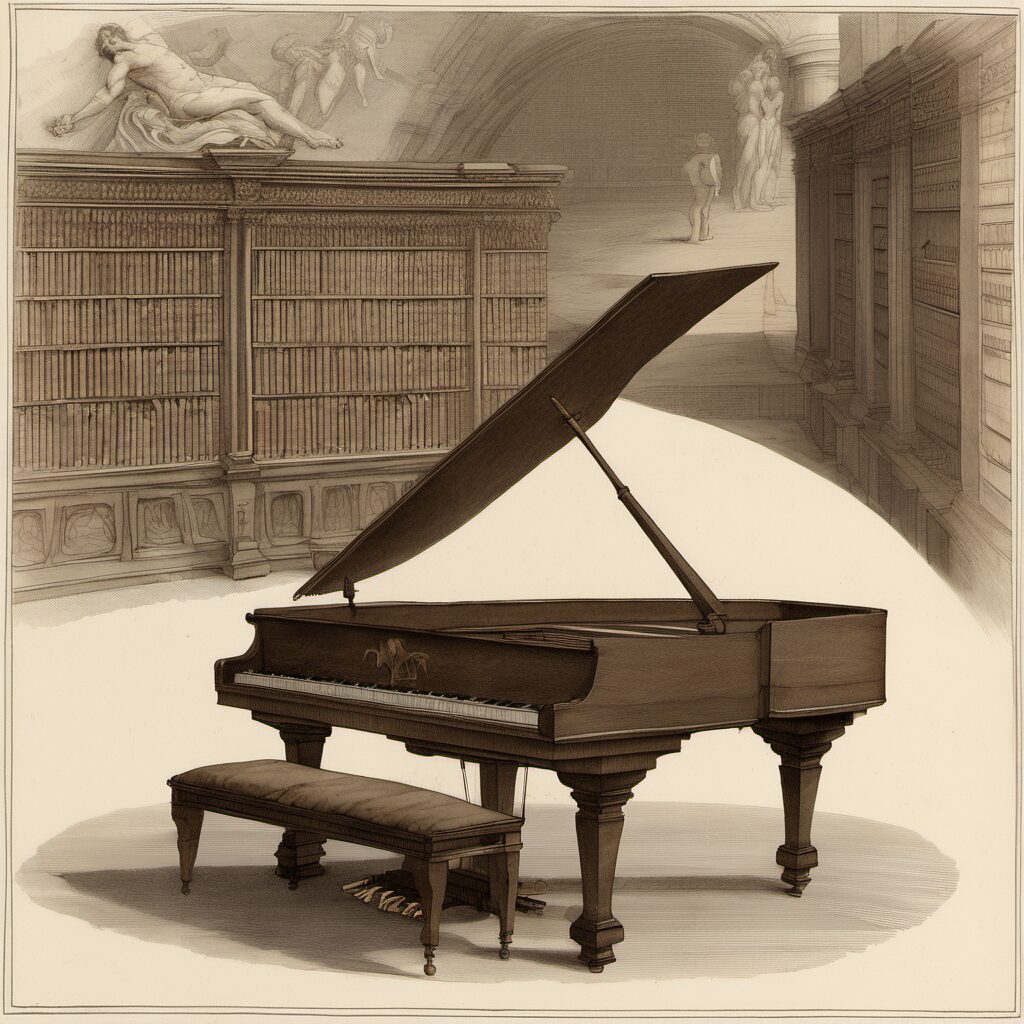
The Prepared Piano – Extending the instrument’s reach into percussion.
The prepared piano, an extension of the traditional piano repertoire, allows for creative exploration of sounds not previously accessible on the standard instrument.
It expands the piano’s range and versatility by incorporating unconventional objects to alter its tone.
In this article, we’ll delve into the world of prepared pianos, examining their history, key techniques, and notable composers who have made significant contributions to the genre.
History of Prepared Piano
The concept of preparing a piano dates back to the early 20th century, with the first recorded instances found in the works of American composer William Sidney Pittrelli (1876-1942).
In 1924, the Italian musician and theorist Ferruccio Busoni proposed a method for using unconventional objects attached between the strings and bridge to create new sounds.
The prepared piano gained popularity during the 1950s and 60s, with notable composers such as Pierre Boulez, Karlheinz Stockhausen, and John Cage experimenting with this innovative approach.
Key Techniques
- Object placement: The placement of objects between the strings and bridge to alter their pitch, tone, or decay.
- Object types: Various materials can be used for preparation, including screws, washers, metal rods, and even everyday items like paper clips or books.
- Dynamics and articulation: Experimentation with different dynamics (loudness) and articulations (attack and release) to achieve unique timbres and textures.
Notable Composers of Prepared Piano Music
- Pierre Boulez – Structures II (1959-1967): A seminal work that showcased the prepared piano’s potential for complex, intricate textures.
- Karlheinz Stockhausen – Telemusik (1966): This piece utilizes the prepared piano to create an otherworldly soundscape, exemplifying the composer’s avant-garde spirit.
- John Cage – Music for Prepared Piano I (1950-1953): A pioneering work that explored the prepared piano’s unique capabilities, paving the way for future generations of composers.
Conclusion
The prepared piano has not only expanded the piano repertoire but also pushed the boundaries of sound and music theory.
As a result, it continues to inspire new compositions and performances, ensuring its relevance in the world of contemporary music.
Visit Wikipedia for more information on this fascinating topic.
You can also watch online some videos about prepared piano at here.
Recommendations: For further exploration, we recommend checking out the works of these notable composers and artists. You can find their music on streaming platforms like Spotify or Apple Music.