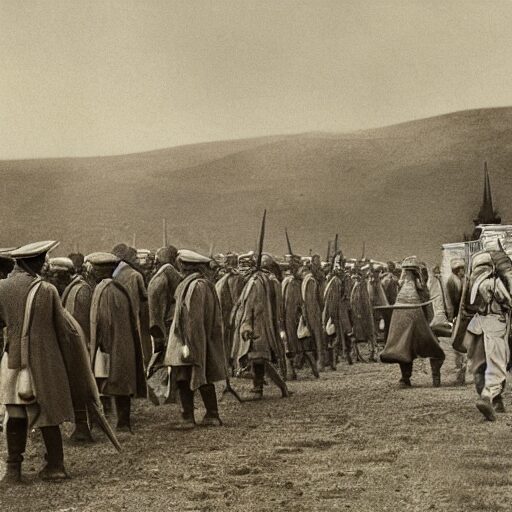
The Apollonian Ideal
Clarity and Restraint in the Shadow of World War I
Throughout the 19th and 20th centuries, the United States served as a model for democratic ideals. The country’s founding values of equality, liberty, and justice, however, were not exported to its global rivals in the same way as to Europe. In an attempt to create a greater global presence, America sought to export its virtues abroad. During World War I, these ideals were tested against those of other nations, with Germany’s militarism posing a particular challenge. In an attempt to find a counterbalance to this, America developed a policy of “restraint” – a policy that saw them taking a less active role in global affairs. This policy was inextricably linked to American ideals of both clarity and restraint, and it was a clear message to Europe that America was not prepared to blindly follow its lead. This policy of “restraint” has been a major influence on American foreign policy and has served as a defining moment in the country’s history. This article will examine the origins of this policy, its impact on America’s international relations, and the legacy it has left behind.
The Apollonian Ideal is a term coined by philosopher Friedrich Nietzsche in his book, Thus Spoke Zarathustra. It is defined as “the principle that the divine must be kept in check, restrained, and confined by the finite – and the finite is in turn constrained and confined by the infinite.” This principle was adopted by Nietzsche as a way of understanding human psychology and behavior, and was linked to the origins of both the Apollonian and the Dionysian ideals. In more recent terms, this term has been adopted by philosopher Jean-Paul Sartre and has been applied to a number of different fields, including psychology, politics, and theology.
During World War I, the United States sought to find a balance between the “restraint” and the “Apollonian” ideals. This was an attempt to find a way for America to continue its global role in the face of the German threat. This policy was not without its critics, as many felt that the country was not doing enough to actively prevent the war from breaking out.
The policy of restraint was linked to a number of different foreign policies. One of the most important was a commitment to democracy, which was seen as a way of promoting the country’s ideals to other nations. The American government also sought to use this policy of restraint to distance itself from Europe and to create greater independence for the nation. This policy also saw America becoming more involved in international affairs, which saw it become involved in a number of conflicts, most notably the Spanish-American War, the Chinese Boxer Rebellion, and the Mexican Revolution. It was also linked to a policy of isolationism, which saw the country withdrawing from global affairs. This was in keeping with the ideals of the Apollonian Ideal, which saw the country turning inward and becoming self-sufficient.
The legacy of this policy of “restraint” can be seen in both the country’s foreign and domestic policies. In the foreign arena, the policy was a success, in that it allowed the country to remain aloof from the global affairs. In the domestic arena, however, the policy was less successful. Despite America’s relative isolation from European affairs, the country was still drawn into the conflict, and the result was a foreign policy of appeasement and of an active role in global affairs. This policy of “restraint” has since been linked to the United States’ role in the world, and it continues to be a theme in American foreign affairs to this day.
In summary, the policy of “restraint” was an attempt by the American government to position itself as a force for global stability and to distance itself from European affairs. This policy was linked to a number of different foreign policies, and while it was successful in the foreign arena, it was less successful in the domestic arena. It has since been linked to a number of different fields, including psychology, politics, and theology, and continues to be a theme in American foreign affairs.
User