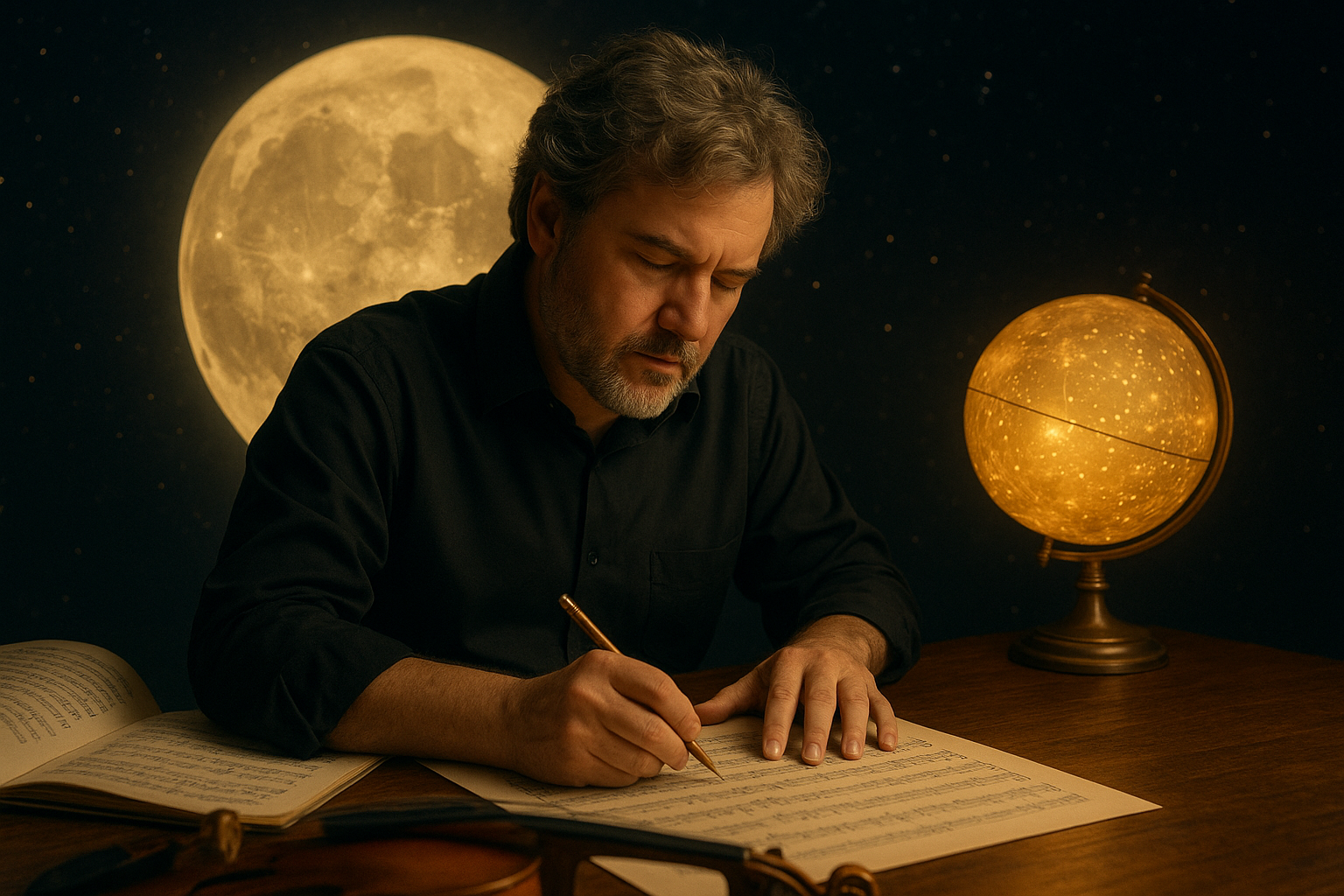
Crafting Celestial Sound: How Composers Evoke the Divine
Throughout history, music has served as a bridge between the mundane and the divine, an art form capable of invoking the ethereal and the transcendent. In this exploration, we delve into the techniques and philosophies that composers use to evoke a sense of the divine within their music. From the solemnity of Gregorian chant to the majestic symphonies of the Romantics, each era of music history offers unique insights into the spiritual aspirations of humanity.
The Foundation of Sacred Music
- Gregorian Chant: Originating in the early Christian Church, Gregorian chant is one of the earliest forms of music explicitly crafted with divine worship in mind. Characterized by its monophonic texture, this form of chant seeks to create a direct conduit between the faithful and the divine. The use of neumes—a system of musical notation introducing a basic sense of pitch and rhythm—helped standardize this sacred tradition.
“The ultimate aim and reason of all music is none else but the glory of God and the recreation of the mind.”
– Johann Sebastian Bach
Baroque Splendor and Divine Complexity
The Baroque period witnessed a flourishing of religious music, where the likes of J.S. Bach, Antonio Vivaldi, and George Frideric Handel mastered the art of polyphony to evoke the heavenly. Bach’s Mass in B minor is a monumental work that employs intricate counterpoint to create a sense of divine majesty and spiritual depth.
- Counterpoint: This technique involves the weaving together of independent melodic lines, creating a tapestry of sound that symbolically reflects the complexity and interconnectedness of the universe. In Bach’s hands, counterpoint becomes a spiritual tapestry, each thread an individual voice lifted in praise.
- Oratorio: Handel’s Messiah stands as one of the quintessential examples of sacred music in this period. Over 50 movements tell the story of Christ’s birth, death, and resurrection, presenting a powerful narrative that transcends its time.
Romantic Idealism and the Search for Meaning
In the Romantic period, composers like Ludwig van Beethoven and Franz Liszt sought to express the sublime within their music, pushing the boundaries of harmony and form to evoke emotion and meaning. Beethoven’s Ninth Symphony, particularly the iconic “Ode to Joy,” represents a universal celebration of brotherhood and divinity.
“Music is the mediator between the spiritual and sensual life.”
– Ludwig van Beethoven
- Program Music: This form of music aims to evoke images or convey the impression of events. Liszt’s Faust Symphony presents a deep metaphysical enquiry into the nature of man and his relation to the divine, illustrating the complexities of the human soul.
- Harmony: Romantic composers expanded harmonic language, using chromaticism to evoke emotional responses that were akin to spiritual experiences, capturing the grandeur and mystery of the divine.
20th Century Innovations and Spirituality
The 20th century saw composers like Igor Stravinsky, Olivier Messiaen, and Arvo Pärt continue to seek the divine through innovative musical means. Stravinsky’s Symphony of Psalms communicates religious themes using a neoclassical simplicity intertwined with modern dissonance.
- Messiaen’s Mysticism: Messiaen, a devout Catholic, infused his works with religious symbolism and influences from non-Western music. His Quartet for the End of Time, composed during his imprisonment in World War II, is a profound meditation on the Apocalypse, using unusual rhythmic patterns and lush harmonies to evoke eternity and grace.
- Minimalism: Arvo Pärt’s tintinnabuli style in works such as “Spiegel im Spiegel” seeks the divine through simplicity, using repetitive patterns and sparse textures to create a sense of calm and introspection.
The Universality of Sacred Music
From ancient chants to contemporary symphonies, the thread of sacred music runs throughout history. It reminds us of our innate yearning for connection with something greater. Composers, by transforming spiritual contemplation into sound, allow listeners to glimpse the divine in the everyday. As we immerse ourselves in these celestial sounds, we find ourselves invited to seek our own dialogue with the divine.
In the words of Leonard Bernstein, “This will be our reply to violence: to make music more intensely, more beautifully, more devotedly than ever before.” As long as there is music, there will be those who seek the divine through its mysterious, ineffable power.
For more information on the techniques used by composers to evoke the divine in music, please visit the Music Theory Online.