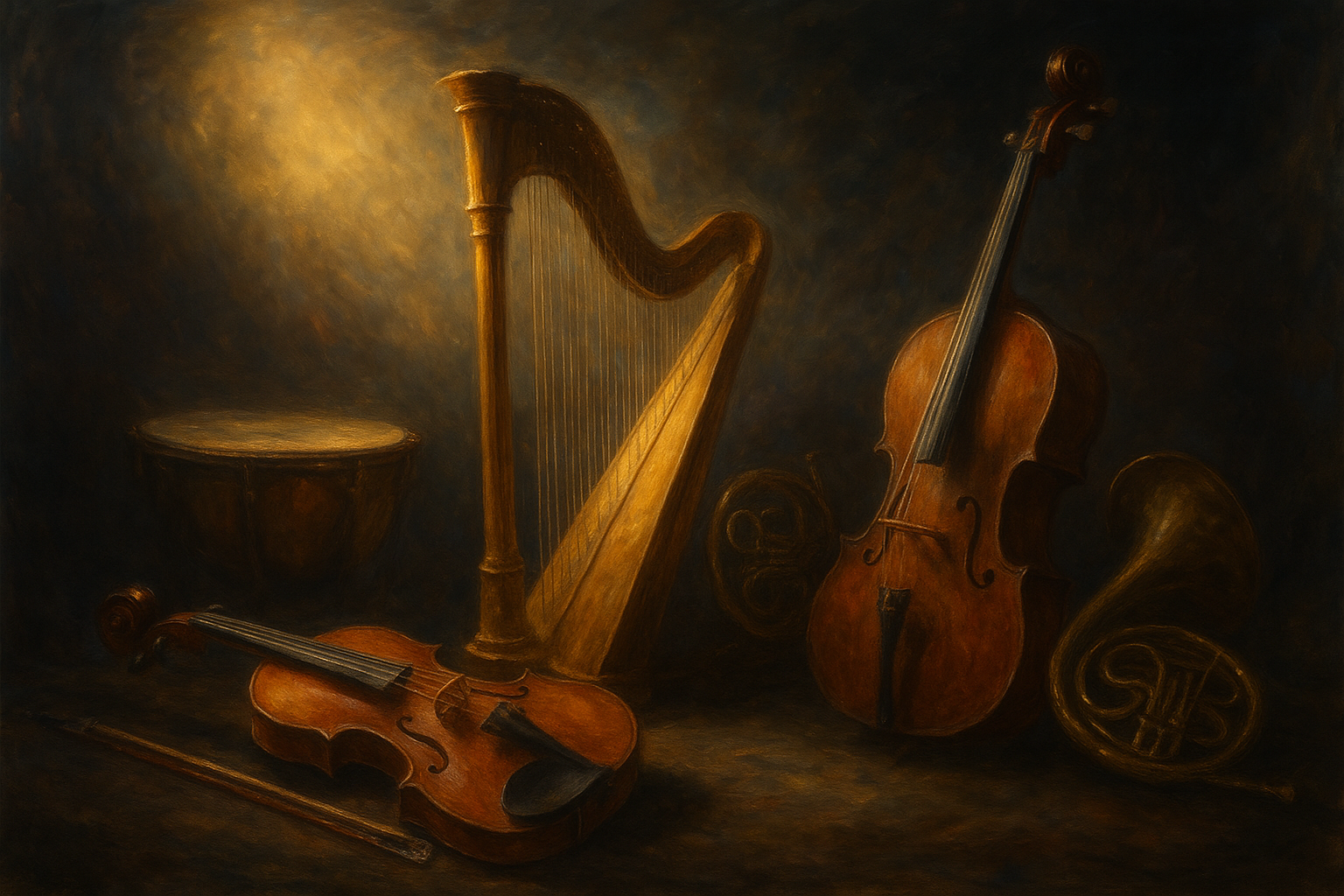
The world of orchestral music transcends mere notes on a page, venturing into the mystical realm where sound and spirit entwine. At the heart of this transformation is timbre, often referred to as the “color” of music. Timbre imbues and animates compositions, offering them a spiritual dimension that connects deeply with listeners.
The Enigmatic Essence of Timbre
Timbre defies easy definition. It is the distinguishing characteristic that enables us to perceive a difference between a flute and a violin, even if they are playing the same pitch and loudness. Renowned composer and conductor Leonard Bernstein encapsulated its essence beautifully when he said, “The most wonderful possibility is that somewhere in this enchanted wood a fairy essence of the unattainable is hovering to be caught, however fleetingly, in some aspect of sound.” (Leonard Bernstein, The Unanswered Question).
Indeed, timbre is the ethereal quality that invokes emotions and imagery within music, acting as a bridge between the auditory and the spiritual.
The Alchemy of Orchestration
Orchestration is akin to alchemy, wherein composers and conductors blend various timbres to create a new, powerful whole. The grand orchestral palette includes strings, woodwinds, brass, and percussion, each contributing a distinct voice to the symphony of sound.
- Strings: Often associated with warmth and expressiveness, strings can evoke a range of emotions from tranquility to intense passion.
- Woodwinds: Known for their rich and varied sounds, woodwinds can mimic natural sounds and evoke pastoral imagery.
- Brass: With their bold and resounding timbre, brass instruments convey power, majesty, and heroism.
- Percussion: Providing rhythm and color, percussion instruments add layers of complexity and excitement.
As composers wield these tools, they craft spiritual narratives that resonate with the mysteries of the human experience. As Claude Debussy once remarked, “Orchestral color, considered purely as such, is no less capable of properly defining the contours and the shading.” (Claude Debussy).
Mysticism and the Power of Sound
The mystical qualities of orchestral timbre have been explored by numerous composers seeking to convey transcendental states. Gustav Mahler, in his symphonies, united celestial sounds to express cosmic themes, bridging heaven and earth. His Symphony No. 8, known as the “Symphony of a Thousand,” is an exemplary work that invests the power of orchestral color to evoke spiritual grandeur.
“A symphony must be like the world. It must contain everything.” – Gustav Mahler
Similarly, Olivier Messiaen explored the spiritual dimensions of timbre, drawing inspiration from religious themes and portraying them through an intricate palette of sound. Messiaen’s Turangalîla-Symphonie exemplifies his fusion of rhythmic complexity and harmonic color, aiming to convey the joy and ecstasy found in divine love.
The Synesthetic Experience
Timbre also plays a crucial role in synesthesia, a phenomenon where the stimulation of one sensory pathway leads to automatic, involuntary experiences in a second sensory pathway. Certain individuals may “see” colors when they hear specific musical notes or instruments, adding a visual element to their auditory experience. This is not confined to rare cases but can occur in varying intensities in many listeners, enhancing their perception of music.
Renowned composer Alexander Scriabin explored this intersection, notably in compositions like Prometheus: The Poem of Fire, which utilized a “light organ” to accompany the music with a changing display of colors.
“I am a moment illuminating eternity…” – Alexander Scriabin
Immersion into the Sublime
The immersive quality of orchestral timbre can transport listeners beyond the concert hall, guiding them on an introspective journey. The powerful, haunting timbre of an oboe solo in a symphonic work can evoke an emotional solitude, while the majestic call of the French horns can invoke images of triumphant vistas.
Orchestral music, with its robust timbral palette, invites audiences to explore hidden depths of consciousness. This spiritual journey is what makes classical music ever-relevant—it is an eternal voyage into the self and beyond.
The Future of Orchestral Color
As technology and musical expression continue to evolve, so does the exploration of timbre. Contemporary composers integrate electronic instruments and computer-generated sounds, further expanding the auditory landscape. This evolution underscores the timeless relevance of timbre—the spiritual essence of sound remains a profound aspect of musical creation.
In conclusion, the spiritual life of timbre and its mystical qualities remain pivotal to the orchestral experience. It acts as the soul of the symphony, an eternal whisper of the esoteric, inviting both musicians and audiences alike to embark on a journey into the mystical realms of sound. As we continue to explore and embrace the colors of music, we find in them reflections of our own shared humanity, uniting us across time and space through the resonant art of orchestral timbre.