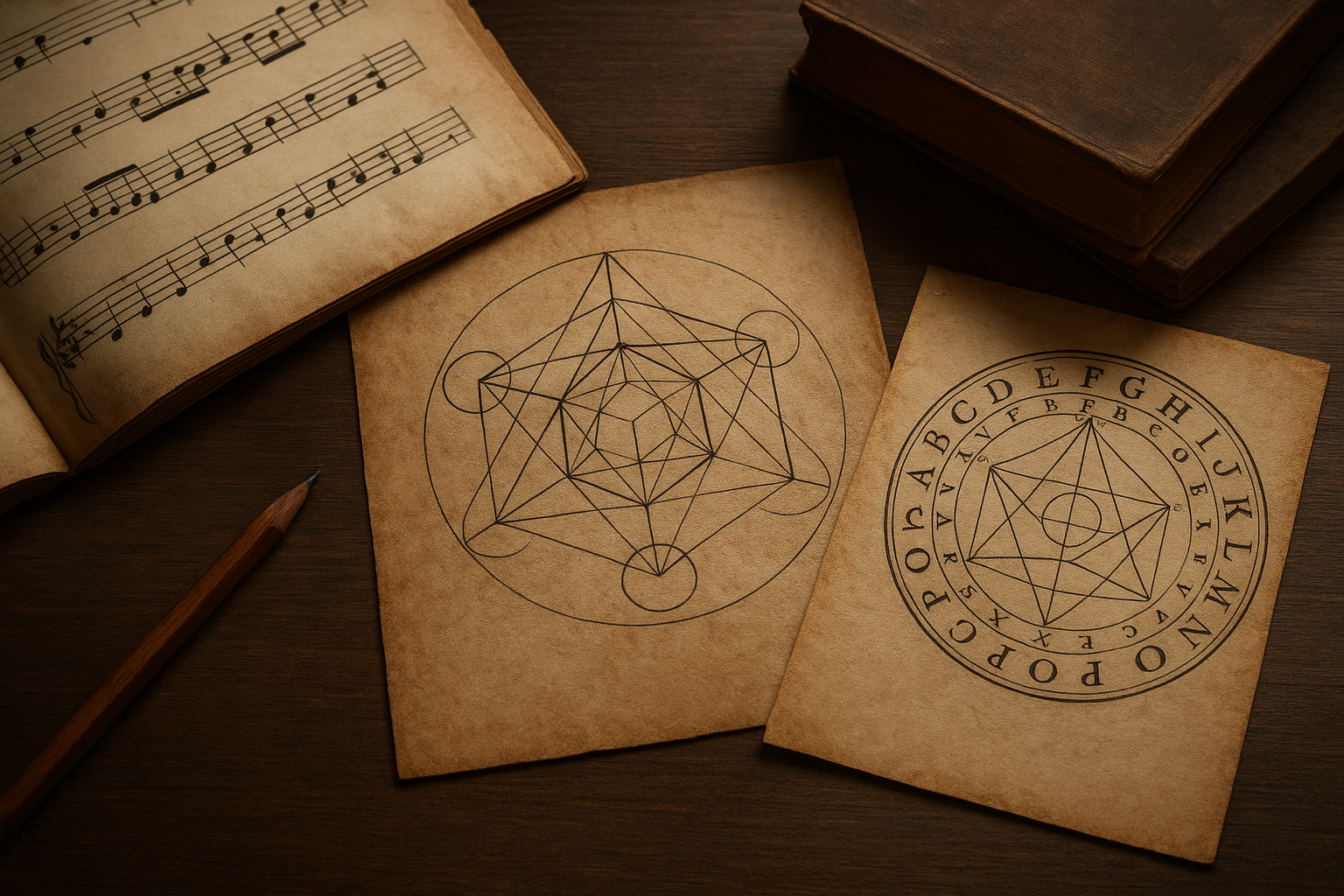
Music and geometry have been intertwined since ancient times, sharing a profound connection that resonates through the annals of cultural and scientific history. This relationship is perhaps most vividly explored through the lens of classical music theory, where sacred geometry uncovers hidden patterns within harmonious soundscapes.
The Harmony of the Spheres
The concept of “Music of the Spheres” dates back to ancient Greek philosophers like Pythagoras and Plato, who believed that celestial bodies produced a form of music through their movements. Pythagoras, in particular, famously proposed that the ratios of musical harmony mirror the proportions found in geometry. This vision of cosmic order revealed how music, mathematics, and the universe were inextricably linked.
“There is geometry in the humming of the strings, there is music in the spacing of the spheres.” – Pythagoras
The Golden Ratio and Musical Composition
The Golden Ratio (approximately 1.618), a ubiquitous pattern in nature and art, also weaves its way through music. Composers from the Baroque to the Romantic period often utilized this divine proportion to achieve balance and beauty in their works. For instance, experts have noted the presence of the Golden Ratio in the compositions of Wolfgang Amadeus Mozart and Frédéric Chopin, where the structure of sonatas and fugues often mirror this mathematical principle.
Mathematics in Motion: The Fibonacci Sequence
Just as the Golden Ratio plays a central role, the Fibonacci Sequence finds a harmonious echo in musical compositions. This sequence, in which each number is the sum of the two preceding ones, is intimately related to the Golden Ratio and appears frequently in the rhythm and structure of music. The meticulous works of Johann Sebastian Bach can be seen as reflections of this sequence, as he crafted compositions that balance unpredictable creativity with mathematical precision.
Contemporary Resonances
Today, the exploration of these hidden patterns continues. Modern composers and musicians, inspired by this historical connection, seek to apply mathematical concepts like fractals and algorithms to create novel musical experiences. The digital age offers limitless possibilities in sound generation, yet the ancient principles of sacred geometry remain a guiding force in musical composition.
As technology evolves, the fusion of music theory and geometry remains a testament to the enduring quest for harmony and order—a reminder that, as we decode the patterns of classical thought, we reveal timeless truths about our universe.