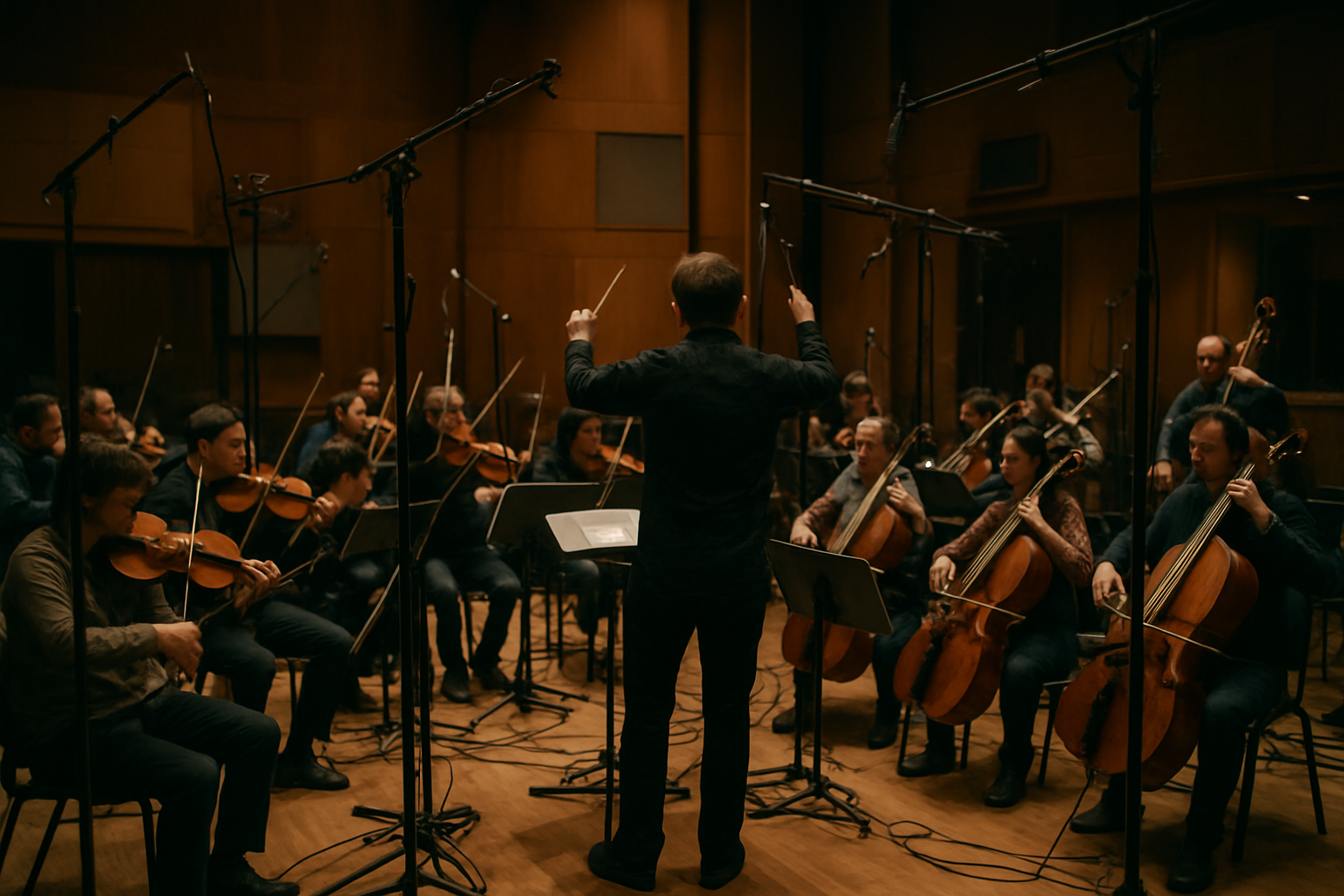
Crafting Orchestral Space: Depth and Dimension in Classical Production
The allure and grandeur of orchestral music rest not only in its melodic and harmonic complexity but also in its ability to create a sense of space, depth, and dimension. From the intricate interplay of instruments to the subtle nuances captured in the acoustics of a concert hall, the production of classical music is a meticulous art that transcends time.
The Acoustic Architecture of the Orchestra
Understanding the physical layout of an orchestra is integral to appreciating how depth is achieved in classical production. Typically, orchestras are arranged with strings at the front, followed by woodwinds, brass, and percussion seated at the back. This arrangement, noted as early as the Classical period, is not arbitrary. It allows the more penetrating sounds of brass and percussion to blend with, rather than overpower, the delicate tones of the strings.
“The arrangement of instruments in an orchestra is fundamentally a study in sound physics.” – Music Theory Today
The Role of Acoustics
Concert halls are designed with specific acoustic properties that amplify the intricate details of an orchestral performance. Renowned halls like Vienna’s Musikverein and the Berliner Philharmonie are celebrated for their superior acoustics, which enhance the richness of sound and provide clarity even in the softest passages. Designing these spaces requires a deep understanding of acoustics, which involves managing variables such as reverberation time, sound reflection, and diffusion.
Reverberation and Its Impact
Reverberation time is crucial in creating a sense of depth, described by Virginia Tech Acoustics as the time it takes for sound to “fade away” in a space. In a large hall, longer reverberation provides a fuller sound, while shorter reverberation creates clarity. This balance is vital for orchestral music, where clarity and richness must coexist.
The Art of Orchestration
Beyond physical arrangements and acoustic settings, the composer’s skill in orchestration plays a vital role in creating spatial depth. Composers like Maurice Ravel and Igor Stravinsky were masters at exploiting the timbre and range of orchestral instruments to craft a multi-dimensional sonic landscape.
- Layering sounds: Orchestrators manipulate instrument sections to create layers, leading to a three-dimensional sound. For instance, the use of sustained string passages sets a sonic foundation, over which woodwinds or brass might introduce harmony and melody, giving depth to the auditory experience.
- Dynamic contrasts: Dynamic variations contribute to the perception of space. A sudden pianissimo after a forte creates an auditory “illusion” of distance, much like visual perspective in painting.
- Use of register: The employment of various instrument registers can effectively suggest space. Higher registers can signal distance while lower pitches can provide grounding proximity.
“Color is the keyboard, the eyes are the harmonies, the soul is the piano with many strings.” – Wassily Kandinsky (in context with music as an art form related to orchestration)
The Recording Revolution
With the advent of recording technology, capturing and reproducing the depth of orchestral space became both a challenge and an opportunity. Stereo recording, for instance, allows for the placement of sound within a spatial field. Modern surround sound and 3D audio technologies have further advanced the possibilities, enabling listeners to experience orchestral music in ways that more accurately reflect live performances.
Stereophonics and Multichannel Audio
- Stereophonic recordings: Introduced in the 1950s, stereo recordings enhanced depth perception through two-channel audio, offering listeners a sense of directionality and space.
- 3D and surround sound: Technologies like Dolby Atmos and DTS:X provide multi-dimensional audio experiences by placing listeners at the center of a spherical sonic field, thus replicating how sound is naturally heard in a concert hall.
As described by Classical Music Magazine, these advancements are not just about technical evolution but also about the artistic intent to craft experiences that are closer to the emotional resonance found in live performances.
Modern Challenges and Techniques
Today’s producers and sound engineers adopt innovative techniques to overcome challenges in classical music production. With digital audio workstations (DAWs), intricate soundscapes can be created, edited, and mixed to enhance spatial perception and provide new dimensions to classical works.
- Sample libraries: High-quality orchestral sample libraries offer a virtual representation of an orchestra, often recorded in renowned halls, allowing for experimentation with space and depth in ways not possible with live recordings alone.
- Artificial reverb and delay: These effects can simulate the acoustics of varying environments, from large cathedrals to intimate chambers, thus crafting the desired spatial ambiance.
- Panning and balance: Adjusting the stereo field and balance of individual tracks allows even further manipulation, reinforcing the immersive quality of orchestral performances.
“The beauty of music is that it’s a moving, living thing – it’s continually shifting and being reinvented through technological advances and artistic exploration.” – David Robertson, Conductor
Conclusion
Crafting orchestral space is both a science and an art, intertwining the geography and physics of sound with the creative vision of composers, conductors, and producers. As the industry continues to evolve with new technologies, the transcendent nature of orchestral music will continue to inspire, drawing listeners into a world where sound possesses space, depth, and dimension.