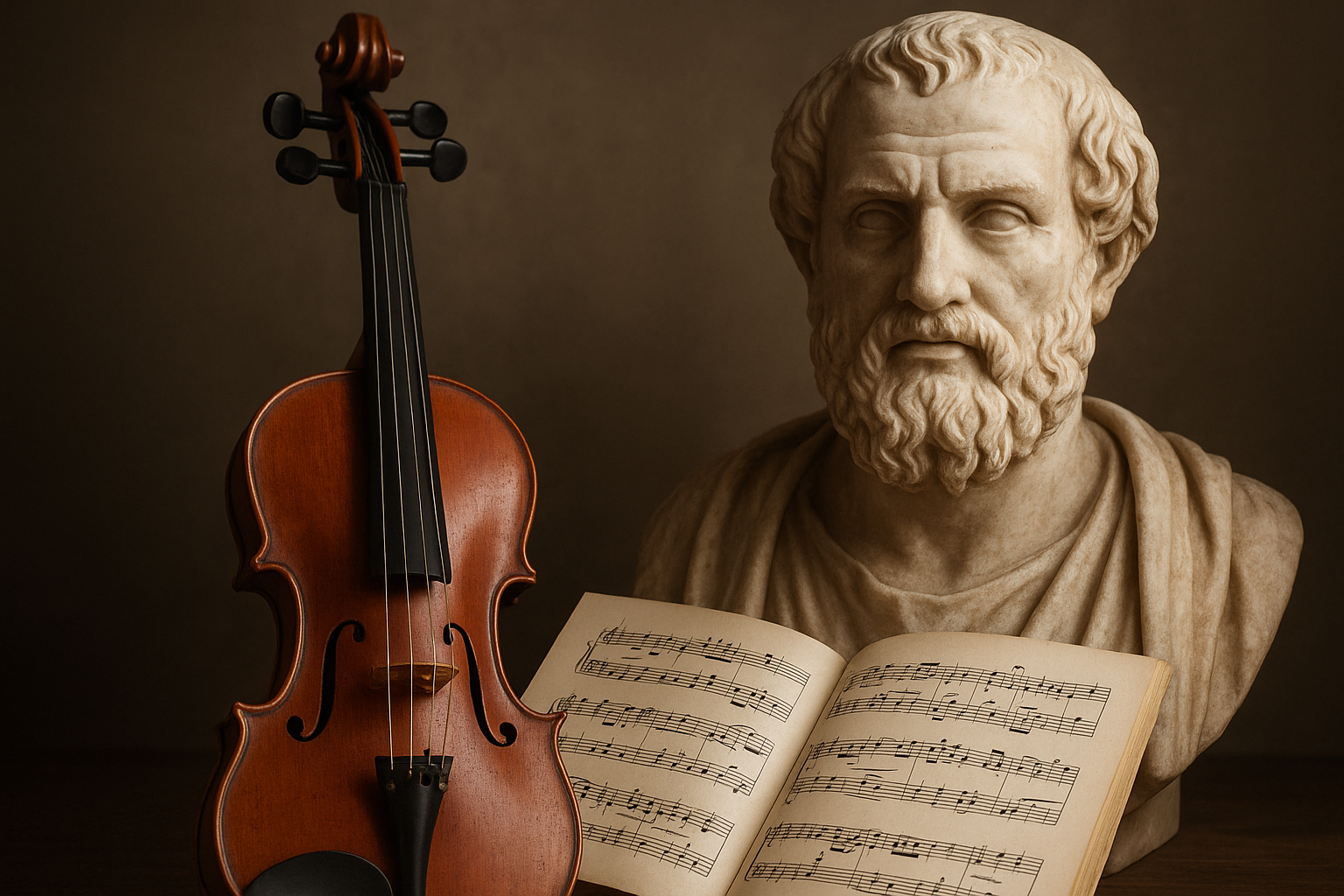
Throughout history, music has transcended the realm of mere acoustics to become a profound form of expression that resonates with the depths of human consciousness. Many philosophers, composers, and musicologists have attempted to articulate the indescribable impact of music on the human soul. This exploration into music as a form of metaphysics seeks to understand why this art form reaches where words often fail.
The Philosophical Foundations
The idea that music is linked to a metaphysical world is not new. In fact, it dates back to Ancient Greece, where philosophers like Pythagoras suggested that music reflects the divine order of the universe. According to Pythagorean thought, the harmony of musical intervals mirrored the harmony of the cosmos, a concept known as the “Harmony of the Spheres.”
Plato shared a similar regard for music as an extension of spiritual truth. In his Republic, he argued:
“…Musical training is a more potent instrument than any other, because rhythm and harmony find their way into the inward places of the soul.”
Plato believed that music was an essential element of education, capable of shaping moral character and fostering an understanding of ideal forms that are otherwise elusive.
Romanticism and the Ineffability of Music
The Romantic era brought with it a heightened appreciation of music as a mysterious, ineffable force. Composers like Ludwig van Beethoven and Franz Schubert created works that communicated emotions and ideas beyond the capacity of language.
- Beethoven famously articulated his belief in music’s metaphysical power when he said, “Music is the one incorporeal entrance into the higher world of knowledge which comprehends mankind but which mankind cannot comprehend.”
- Schubert’s compositions, imbued with melancholy and longing, have been described by critics as touching “the margin of the ineffable.”
For these composers, the quintessence of music lay in its ability to evoke profound emotional experiences and transcend the limitations of verbal expression.
The 20th Century: Music as Universal Language
The 20th century saw a shift in the metaphysical understanding of music, with composers like Igor Stravinsky and Arnold Schoenberg challenging the tonal systems that had dominated Western music for centuries. Stravinsky reflected on the philosophy of music and its ineffable qualities:
“Music is, by its very nature, essentially powerless to express anything at all.”
This radical view underscores the idea that the mystery of music does not lie in providing answers but in its capacity to evoke a universal human experience that transcends cultures and individual differences.
The Modern Perspective
Today, music continues to be seen as a form of metaphysics that captures the ineffable. With advances in technology and a deeper understanding of psychology and neuroscience, we begin to grasp the complex interactions between music and the brain.
- Neuroscientists have found that music activates every known part of the brain, suggesting that it has a deep evolutionary significance.
- Psychologists propose that the abstract nature of music allows listeners to project their own meaning onto it, making it a personal, mystical experience.
Lisa Feldman Barrett, neuroscientist and psychologist, explains in her book, How Emotions Are Made, that music is “the language of emotion,” serving as a vehicle through which we can understand and articulate our latent feelings.
Conclusion
Throughout centuries, the enduring allure of music as a metaphysical pursuit persists. It continues to be a sacred thread that weaves through the fabric of human spirituality and is cherished for its ability to articulate the unutterable and evoke the profound.
Despite countless attempts to rationalize and describe its power, music remains one of humanity’s most beautiful mysteries—an ineffable link to the metaphysical realm that defies the confines of language. In the words of Victor Hugo:
“Music expresses that which cannot be put into words and that which cannot remain silent.”