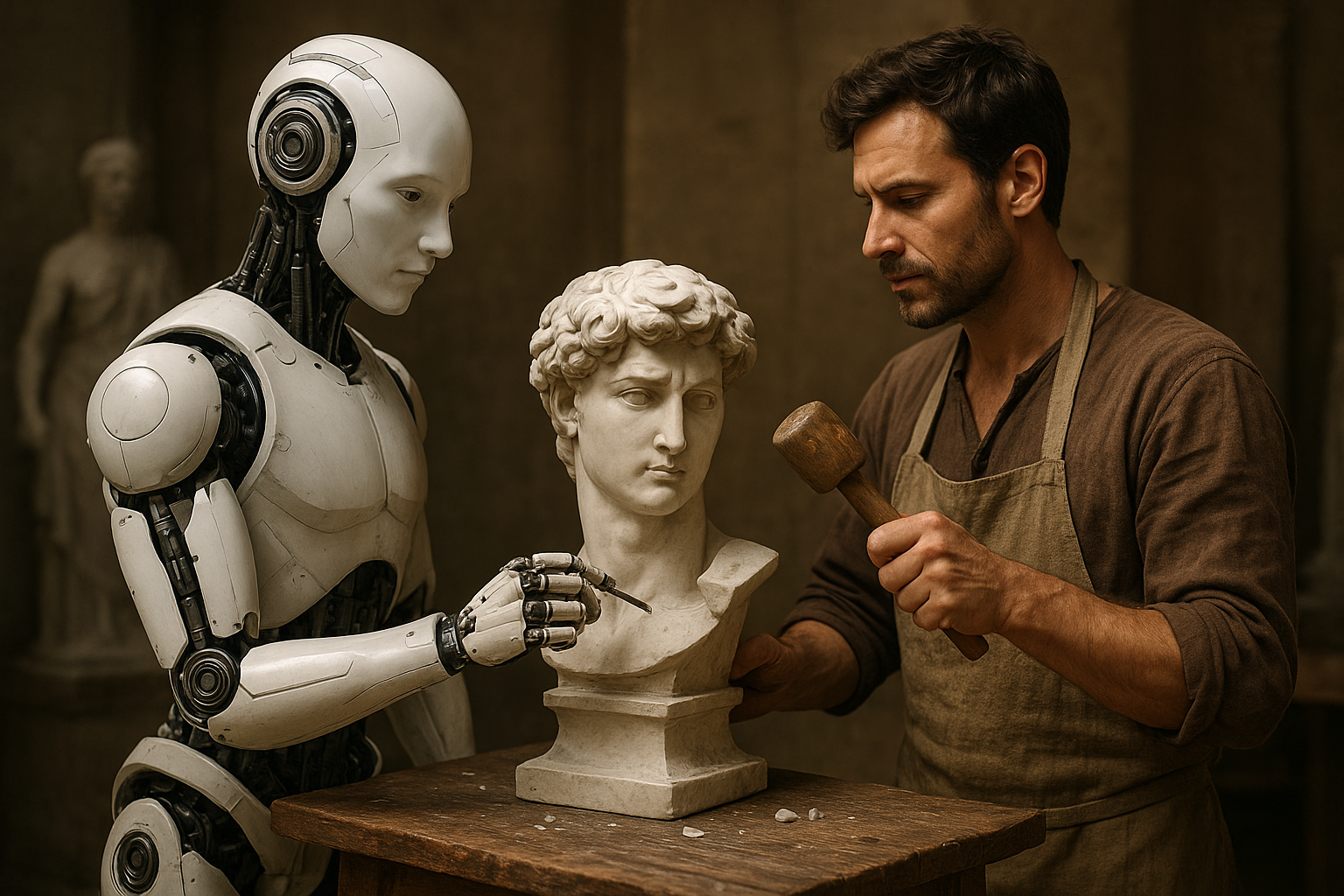
AI as a Modern Apprentice: Classical Reinventions in the Digital Era
The digital age has ushered in advancements in technology that have revolutionized many aspects of modern life. Among these advancements, Artificial Intelligence (AI) stands out as a particularly transformative force. In many ways, AI has come to function as a modern apprentice, learning and evolving to meet the diverse needs of today’s world. Just as apprenticeships in the classical era provided hands-on learning experiences that were pivotal for the development of skills, AI is now embarking on a similar journey, reinventing classical roles in unexpected and profound ways.
AI’s Role as a Modern Apprentice
Traditionally, apprenticeships involved young learners studying under experienced mentors to gain practical, hands-on training in a particular field. In the digital era, AI acts as the apprentice by absorbing vast amounts of data and learning from its environment to collaborate with humans.
- Healthcare: AI is revolutionizing the medical field by taking on tasks such as diagnostics and personalized treatment plans. For instance, AI algorithms can analyze medical imaging with remarkable accuracy, identifying conditions that might elude even seasoned professionals. The study published in Nature demonstrated that AI could outperform human radiologists in detecting breast cancer in mammograms.
- Finance: In finance, AI systems perform complex trading tasks, risk assessments, and fraud detection. By learning continuously, these systems provide insights and predictions that would typically require years of human experience.
- Education: AI-based personalized learning platforms are remaking education by catering to individual student needs, learning paces, and styles. This personalized attention mimics an apprenticeship model where the “apprentice” AI analyzes and adapts information for optimal learning outcomes.
The Evolution of Apprenticeships in the AI Era
The essence of an apprenticeship lies in continuous learning and adaptation—abilities that AI excels at. As AI systems become more sophisticated, they offer capabilities that mirror those of human apprentices, albeit at a much larger scale. According to the McKinsey Global Institute, AI could potentially deliver additional global economic activity of around $13 trillion by 2030, boosting global GDP by about 1.2% a year.
“AI is becoming capable of performing tasks that have historically required human judgment, decision making, and analysis,” says the report from McKinsey.
Challenges and Ethical Considerations
As AI continues its path as the modern apprentice, it also poses certain challenges:
- Bias and Fairness: AI systems are trained on data that can sometimes reflect human prejudices. Ensuring that these systems remain fair and unbiased is a significant challenge that requires ongoing attention.
- Job Displacement: The automation of tasks traditionally performed by humans raises concerns about job displacement. While AI can improve productivity, it also necessitates a continuous discussion about the reorientation of labor.
- Ethical Frameworks: The deployment of AI technologies must be guided by robust ethical frameworks. As AI systems often make decisions that affect human lives, these frameworks are crucial for ensuring that AI acts as a responsible apprentice.
AI and Human Collaboration
The ultimate goal is not to replace human intellect and creativity but to enhance them. The synergy between AI and human expertise allows new dimensions of innovation to emerge. This collaborative dynamic creates a new breed of ‘machine-aided apprentices’ where AI assists in tasks, giving humans more time to focus on creative and complex problem-solving aspects. “The future of AI is not about man versus machine, but rather min and machine working together,” says Soumitra Dutta, a professor at Cornell University.
Conclusion
As AI continues to develop, its role as a modern apprentice becomes ever more critical. By learning from data, methods, and its own experiences, AI is reinventing traditional roles across various industries. The collective aspirations to build intelligent systems that collaborate effectively with humans will ensure that AI thrives not as a competitor but as an apprentice, ultimately leading to breakthroughs that were once thought impossible.
Thus, the digital era presents a unique opportunity to reimagine and reinvent the age-old concept of apprenticeships through AI, heralding a new age of learning and growth.