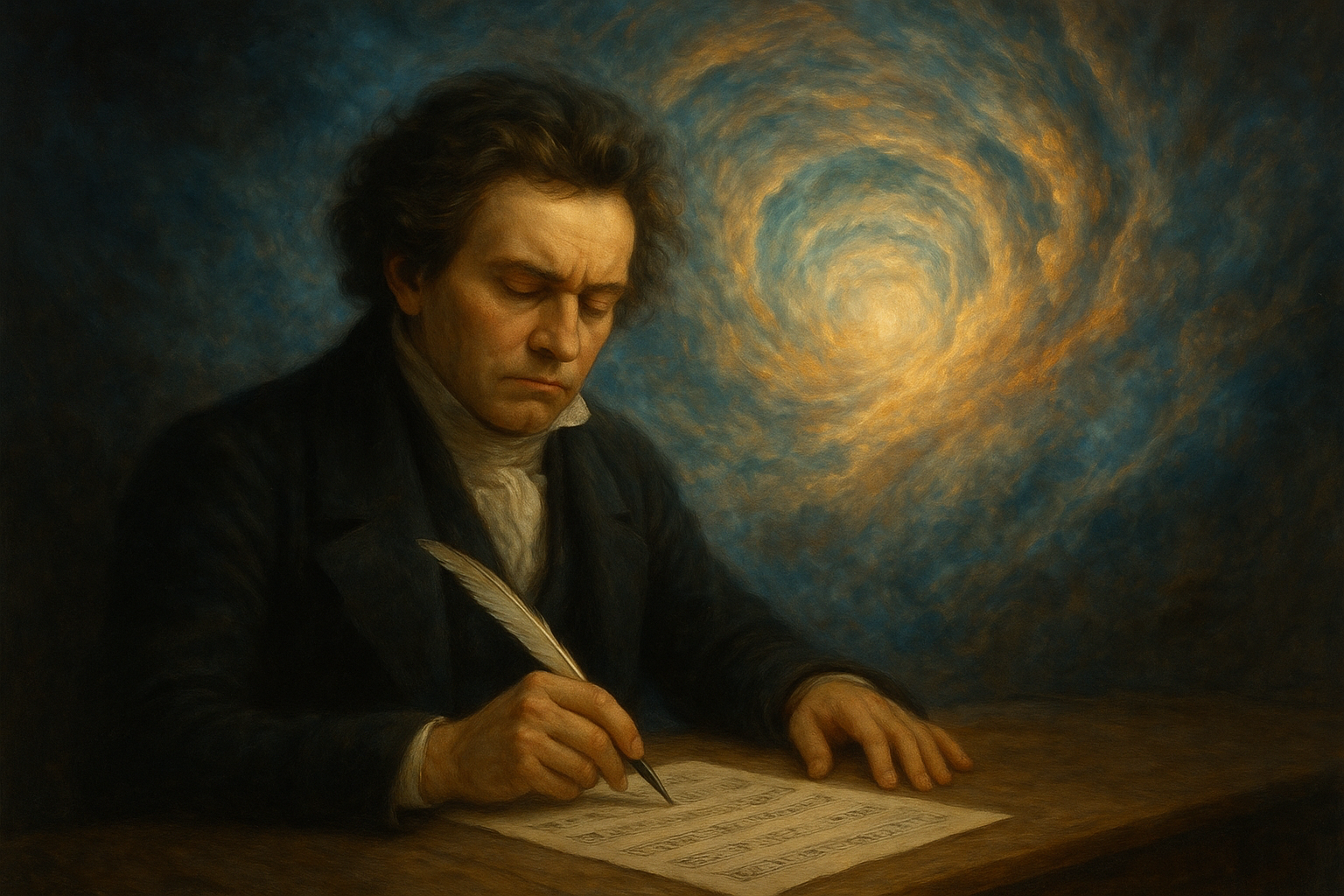
Throughout history, many composers have been inspired by events and experiences beyond the ordinary. These mystical and transcendental experiences have often shaped the creation of some of the most profound and moving music. This article explores these unique and unexplained phenomena and how they influenced the works of celebrated composers.
The Spiritual Awakening of Beethoven
Ludwig van Beethoven, one of the most celebrated composers of the Western classical music tradition, grappled with a myriad of personal challenges, including his encroaching deafness. Despite these struggles, or perhaps because of them, Beethoven experienced a profound inner awakening that significantly influenced his later compositions.
“Music is the mediator between the spiritual and the sensual life,” Beethoven declared, encapsulating his belief in the transcendent power of music.
The Ninth Symphony, particularly the choral finale with “Ode to Joy,” is considered a manifestation of Beethoven’s spiritual vision. According to The Journal of Musicology, this piece represented a kind of universal brotherhood and peace, a message Beethoven hoped would transcend his own suffering and resonate with all of humanity.
Messiaen’s Visions and Colours
Olivier Messiaen, a 20th-century French composer, is renowned for his ethereal and distinctly spiritual compositions. Messiaen experienced synesthesia, a condition where one perceives numbers or letters as inherently colored. He purportedly translated these vivid personal experiences into his music, creating works that were deeply spiritual and visually inspiring.
In a 1986 interview with The Rest is Noise, Messiaen explained, “My music is colored; if not, I do not see it…I see colors which translate in musical terms.” His masterpiece, Turangalîla-Symphonie, exemplifies this phenomenon. The symphony is described as a kaleidoscope of colors, reflecting Messiaen’s deep appreciation for the spiritual connection between sound and sight.
Sibelius and the Finnish Landscape
Jean Sibelius, Finland’s national composer, drew deeply from the mystical landscapes and folklore of his native country. His compositions often echo the serene and haunting beauty of Finland’s natural environment. This connection to nature is profoundly evident in his famous work, Finlandia, which paints a soundscape that captures the soul and spirit of the Finnish identity.
“The essence of my work has always been to strive towards the mystical,” Sibelius noted in a letter to a close friend. “Nature brings me a sense of inner peace and mystical connection.”
The composer’s symphonies, particularly the mysterious and sparse Symphony No. 7, were also heavily influenced by Finland’s natural beauty and his own personal affinity for the mystical and spiritual.
Arvo Pärt and the Tintinnabuli Style
Estonian composer Arvo Pärt is known for his minimalist style, known as tintinnabuli. This approach emerged after Pärt’s conversion to Orthodox Christianity in the 1970s, a time when he withdrew from public life to study medieval and Renaissance music. His spiritual and mystical experiences during this period led to compositions that resonate with a deep sense of contemplation and timelessness.
According to The Guardian, Pärt’s music, characterized by simplicity and stillness, evokes a meditative quality that draws listeners into its spiritual and mystical depths. Works like Fratres and Spiegel im Spiegel are imbued with a luminescence that reflects Pärt’s quest for inner peace and spiritual enlightenment.
Philip Glass and Tibetan Buddhism
Composer Philip Glass is often associated with minimalism, but his music has been profoundly influenced by his study of Tibetan Buddhism. His opera Satyagraha, which draws from the teachings of Mahatma Gandhi, and Symphony No. 5, titled Requiem, Bardo, Nirmanakaya, explore Buddhist concepts of life, death, and rebirth.
In a Interview Magazine feature, Glass revealed, “Buddhism teaches us about the nature of mind and reality—in my compositions, I aspire to express these complex relationships.”
Glass’s association with Buddhism infuses his work with a reflective and meditative quality, striving to convey mystical experiences through repetitive structures and harmonic progressions.
The Sustaining Power of Musico-Spiritual Experiences
The intersection of music and mystical experiences offers a profound insight into the composer’s inner world. Whether through Beethoven’s spiritual resilience, Messiaen’s synesthetic visions, or Glass’s Buddhist enlightenment, these experiences have birthed masterpieces that transcend time and cultural boundaries.
As these composers demonstrate, mystical experiences can push the boundaries of human creativity, allowing for the creation of music that not only speaks to the soul but also reaches into the metaphysical realm. In doing so, these compositions provide not just entertainment but a spiritual journey—both for the composer and the listener.
While we may never fully understand the mystical inspirations behind the masterpieces, we are privileged to experience their transcendent beauty and power. As Messiaen once mused, “The aim of music is not to please, but to spiritualize and elevate—the ultimate aim is an awakening of one’s own spirit.”