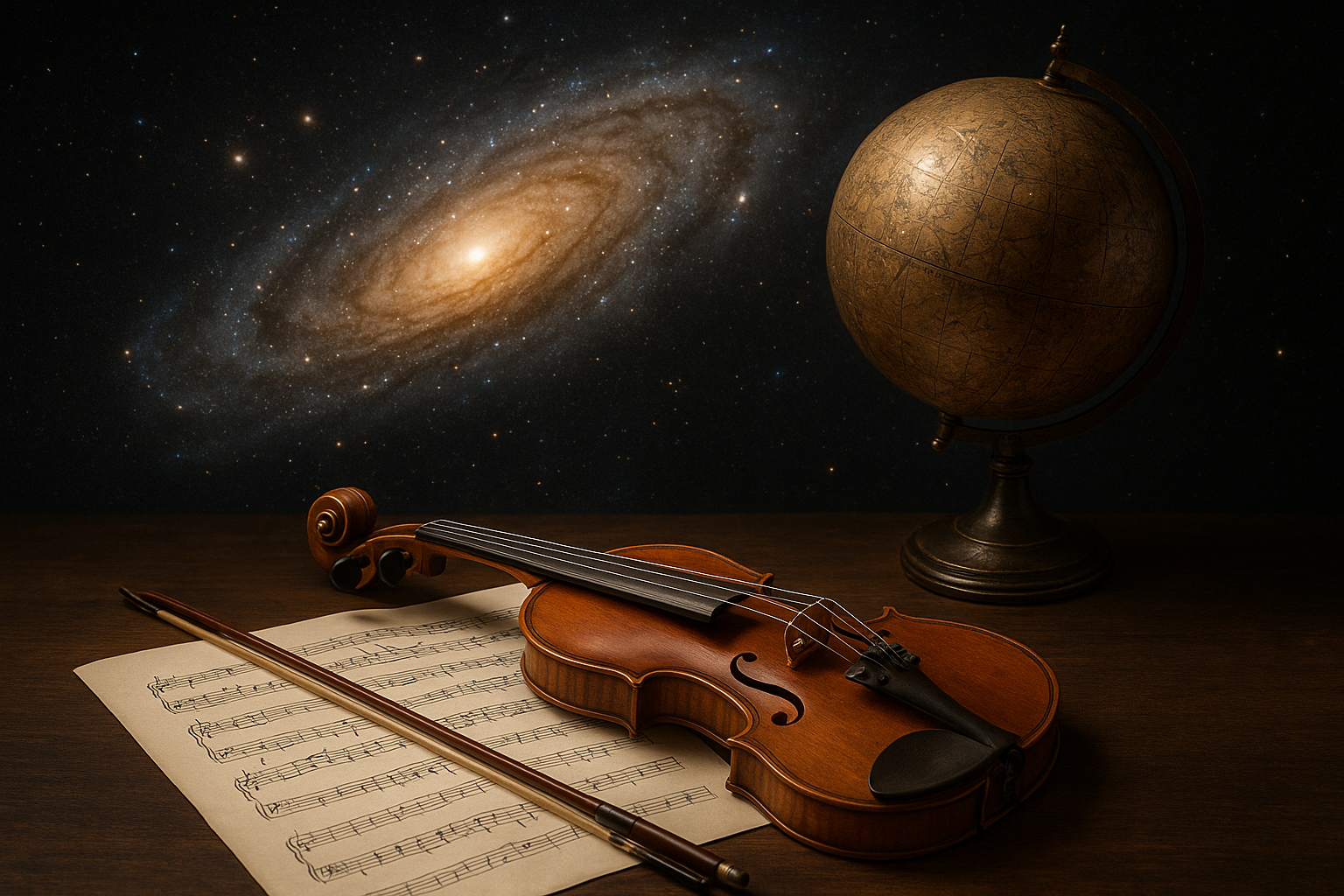
The interplay between music and the cosmos has long fascinated artists and scientists alike. As we explore the universe, composers draw inspiration from the infinite vastness of space, intertwining their sonic works with cosmological themes to reflect the grandeur and mystery of the natural world.
The Cosmic Symphony
Throughout history, composers have looked to the stars and the universe for inspiration. The movement of celestial bodies and the vastness of space provide fertile ground for creative minds seeking to capture the infinite in musical form. German composer Gustav Holst famously created “The Planets”, a seven-movement orchestral suite, with each movement named after a planet in the solar system and its corresponding astrological character.
“In the mirrored heavens, I see the reflection of the music of the spheres,” Holst once remarked, underscoring the profound connection he felt between music and the cosmos.
Structures Inspired by Cosmic Phenomena
Modern composers continue to draw from cosmic phenomena to inform their works. These musicians often employ advanced techniques and structures to evoke the complexity and beauty of the universe.
- Microtonal Compositions: The use of microtonal scales, which include pitches outside the traditional Western 12-tone system, allows composers to imitate the expansive and often dissonant nature of cosmic sounds.
- Electroacoustic Techniques: By incorporating electronic elements, composers create otherworldly soundscapes that suggest the sounds of the cosmos, such as the concept of space sonification.
- Fractal Structures: Employing mathematical concepts, such as fractals, can result in compositions with self-similar patterns across different scales, mirroring the repeating patterns found in nature.
The Contemporary Cosmic Composer
One prolific contributor to this genre is American composer John Luther Adams, who continually explores the intersection of music and nature. His award-winning piece, “Become Ocean,” is a meditative and expansive orchestral work reflecting on rising tides, climate change, and the powerful forces of nature.
“I hope to create music as profound and mysterious as the ocean itself,” Adams stated, as cited in The New York Times.
As our understanding of the cosmos continues to expand, so too will the possibilities for classical compositions. By drawing on the infinite beauty and mystery of the universe, composers continue to craft works that inspire, provoke, and transcend the earthly confines.