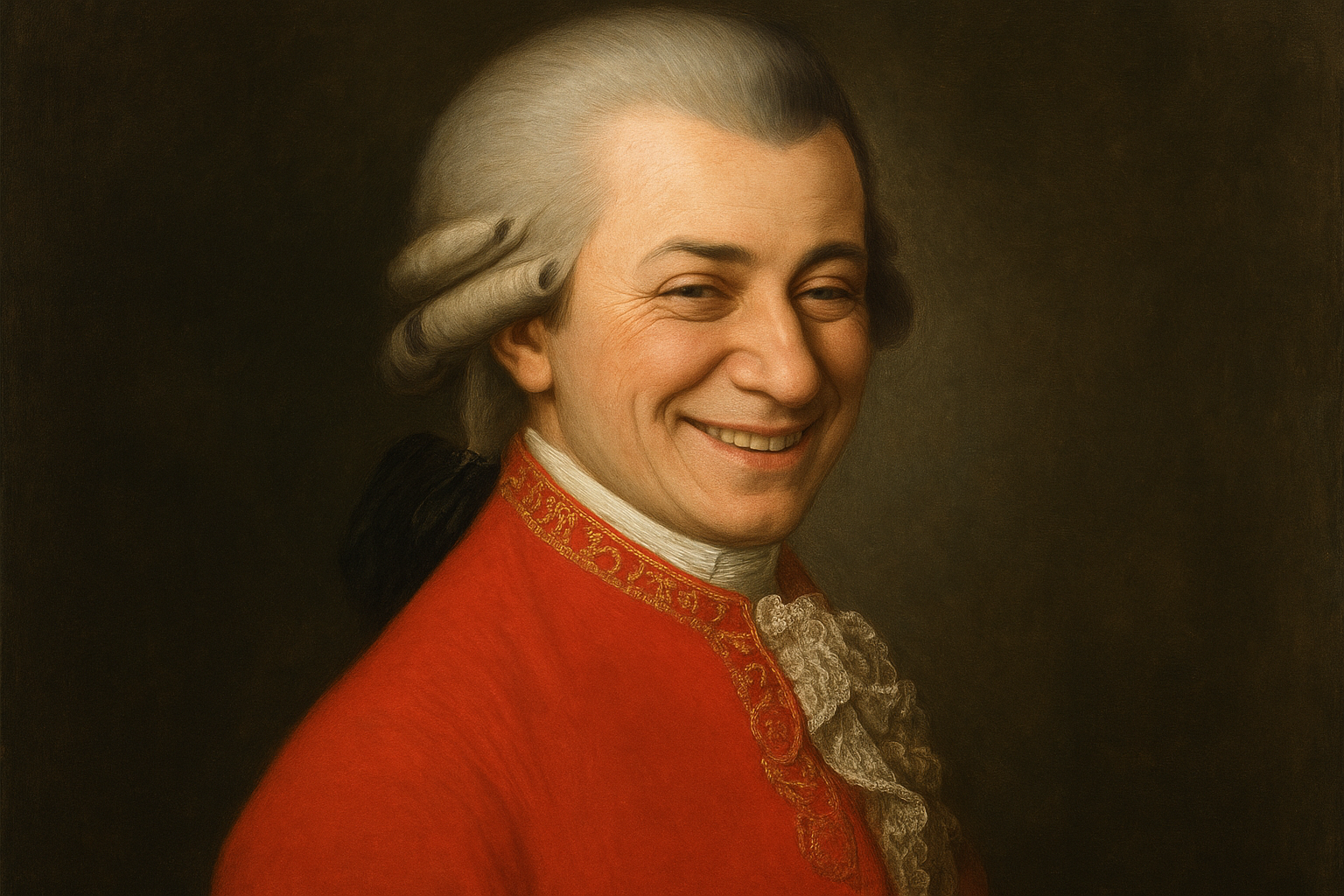
The echoes of Wolfgang Amadeus Mozart’s music have reverberated through the corridors of time, transcending generations and enthralling listeners with their unparalleled brilliance. Among the many attributes of his compositions is an enigmatic quality often referred to as the “eternal smile.” This phrase describes the joyous and uplifting nature prevalent in Mozart’s phrasing, an element that distinguishes his work and continues to inspire both performers and audiences.
“Mozart combines serenity with a wild, unique gaiety that belongs to no one else. The effect is as if that gaiety were born of a depth of feeling all his own.” — Maurice Ravel
Lightness and Precision
This elusive quality, often dubbed as “divine joy,” is embedded in the very structure of his music. Mozart’s expert use of harmony, balance, and phrasing brings a distinct lightness and precision that permits each note to breathe with clarity. Leonard Bernstein, in his Norton Lectures at Harvard University, marveled at Mozart’s effect, noting that his music projects a “sublime human quality.” Indeed, Mozart’s compositions encapsulate an innate joy that appears almost effortless.
- Harmony: Mozart’s masterful use of harmonic structure evokes a sense of completeness and fulfillment.
- Balance: The well-proportioned phrases create a sense of symmetry and satisfaction.
- Melody: His uncanny ability to craft memorable melodies contributes greatly to the overall sense of joy and vitality.
Interpretation and Emotion
Interpreters of Mozart’s music often cite the challenge of capturing this “eternal smile.” Pianist Mitsuko Uchida expresses in an interview with the BBC that playing Mozart requires both “transparency and strength,” emphasizing that every note must carry its own emotional weight and resonance.
Performing Mozart is a delicate balancing act—a dance between discipline and spontaneity. The musician must embrace the lightheartedness of his music while conveying the profound depth beneath. This duality is where Mozart’s genius lies: the ability to reflect the full spectrum of human emotion, often within the span of a few bars.
Mozart’s Legacy
Ultimately, Mozart’s “eternal smile” is not merely a musical technique but a reflection of his enduring legacy. It serves as a reminder of the transcendent power of music to connect, uplift, and inspire. Through his compositions, Mozart invites us to experience a divine joy that, much like his music, remains timeless and eternal.