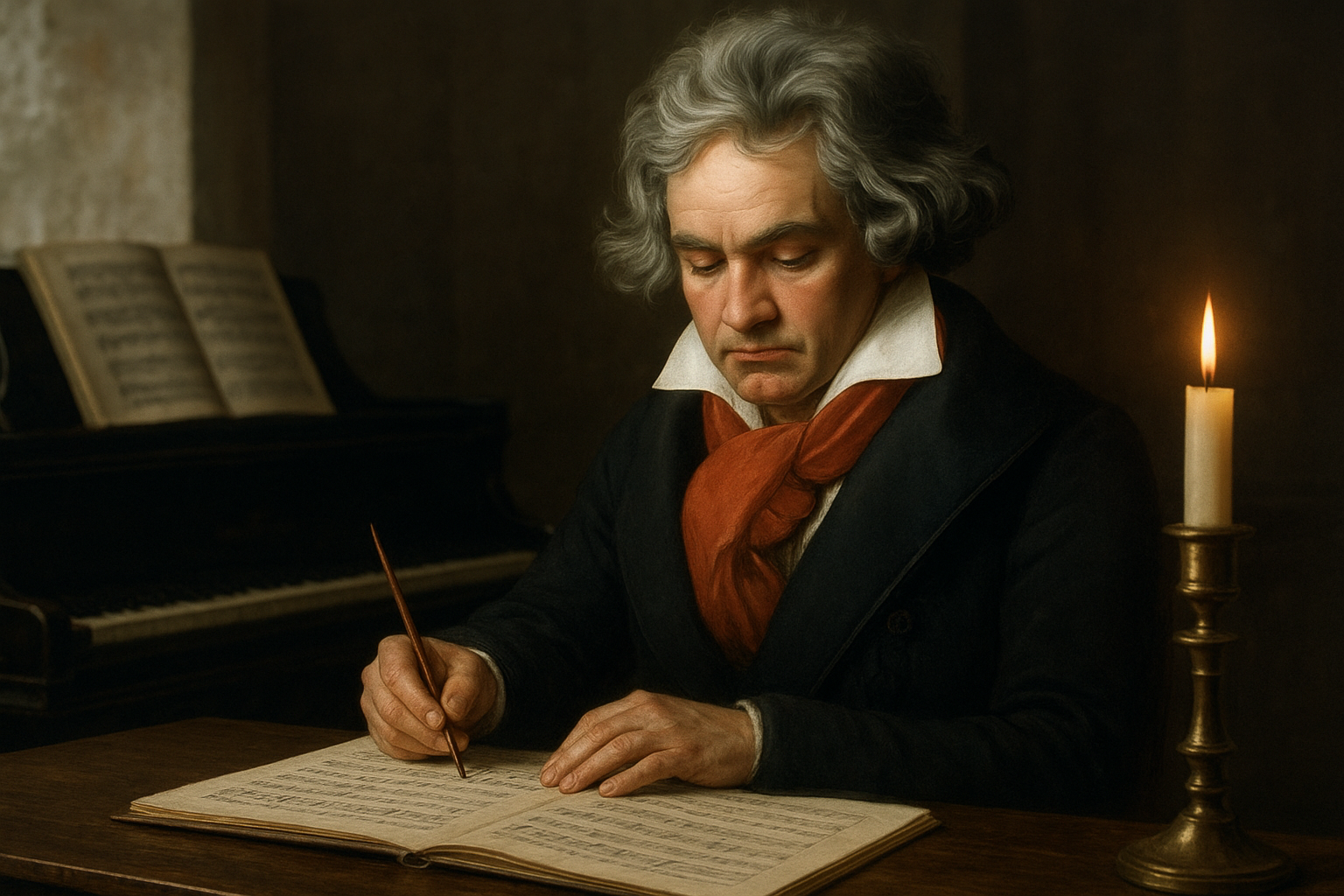
The intertwining of music and transcendence is a tale as old as civilization itself. Among the architects of sonic experiences that nudged humanity towards the sublime, classical composers stand resolute. As vessels of divine introspection and emotional exploration, these musical maestros have continually reshaped the symphony of human experience, each note a step towards the infinite.
The Divine Spark: Inspiration from the Celestial
Throughout history, composers have been moved by visions of the metaphysical, crafting works that defy earthly confines. This search for higher meaning is evident in the oeuvres of composers like Ludwig van Beethoven, Johann Sebastian Bach, and Franz Schubert. Beethoven, whose deafness only sharpened his inner sense of sound, famously said,
“Music is a higher revelation than all wisdom and philosophy.”
His compositions often aimed to reflect universal truths, creating soundscapes that resonated with a sense of the divine.
Bach: The Bridge Between the Earthly and the Divine
Johann Sebastian Bach, often cited as the grand architect of polyphonic music, integrated religious themes into his music with unparalleled mastery. In works like the Mass in B Minor, Bach’s compositional genius is not just in the complexity but in its ability to evoke a sense of divine wonder. Each contrapuntal piece weaves together myriad voices into a coherent, spiritual whole that speaks to the listener’s soul.
Particularly, Bach’s use of cantatas – a vocal composition with an instrumental accompaniment, typically in several movements, often involving a choir – highlights his spiritual devotion. The St. Matthew Passion, for instance, remains a sublime example of Bach’s ability to channel religious narrative into a transcendent musical experience.
Beethoven: The Heroic and Mystical Journeys
Ludwig van Beethoven, whose life was a constant battle against personal demons, sought solace and expression in the spiritual transcendence that music could offer. His Ninth Symphony, particularly the final choral movement, is a triumphant ode to joy that exalts the unity of all humanity. The inclusion of Friedrich Schiller’s poem “Ode to Joy” as the choral element symbolizes a collective ascent toward spiritual and moral heights.
Beethoven’s Missa Solemnis further exemplifies his yearning for eternity. Composed during his personal and auditory struggles, this mass was Beethoven’s attempt to encapsulate faith and transformation, a sonic tapestry bridging the human and the divine.
Schubert: Melancholy and Sublimity
Franz Schubert, a composer deeply attuned to the delicate interplay between emotion and eternity, is another quintessential figure in the domain of transcendental music. Schubert’s Winterreise song cycle, with its introspective lyrics and haunting melodies, guides listeners through a profound exploration of human emotion and existential longing.
Schubert’s liturgical works, particularly the Mass No. 6 in E-flat major, combines the ethereal with the mortal, as it transcends conventional melodic structures for a spiritual resonance that echoes with the divine’s solemnity.
Music as a Vessel of Human Emotion
- Romanticism: The Romantic era of classical music emphasized emotional expression, with composers like Franz Liszt and Richard Wagner pushing boundaries to channel transcendence through heightened emotional landscapes.
- Lyricism and Drama: Lingering melodies and dramatic crescendos became tools for composers to evoke emotions that were deeply personal yet universally resonant. This facilitated a shared experience of transcendental states.
Modern Echoes of Transcendence in Composition
The quest for transcendence did not halt with the classical era. Composers like Olivier Messiaen and Arvo Pärt continue to wield music as a bridge to the divine. Messiaen’s works, such as the Quartet for the End of Time, reflect his deep Catholic faith and his interest in creating music that transcends time and death.
Arvo Pärt, known for his minimalist style, invokes spirituality in its starkest form. His composition Spiegel im Spiegel is a poignant reminder of the divine within the mundane, using simplicity to evoke a profound sense of peace and reflection.
The Legacy of Transcendental Music
The legacy of classical composers who channeled transcendence is reflected in every note that seeks to explore the unknown, every symphony that dares to touch the heavens. Through their compositions, they have provided a means to connect with something larger than ourselves, offering solace, inspiration, and understanding.
As we listen to their music, we are reminded of the profound capacity of sound to cross boundaries, to unite, and to uplift. These visionaries have left behind not just a soundscape of their time but a spiritual blueprint for generations to come, inviting us forever to look beyond the horizon of the score.