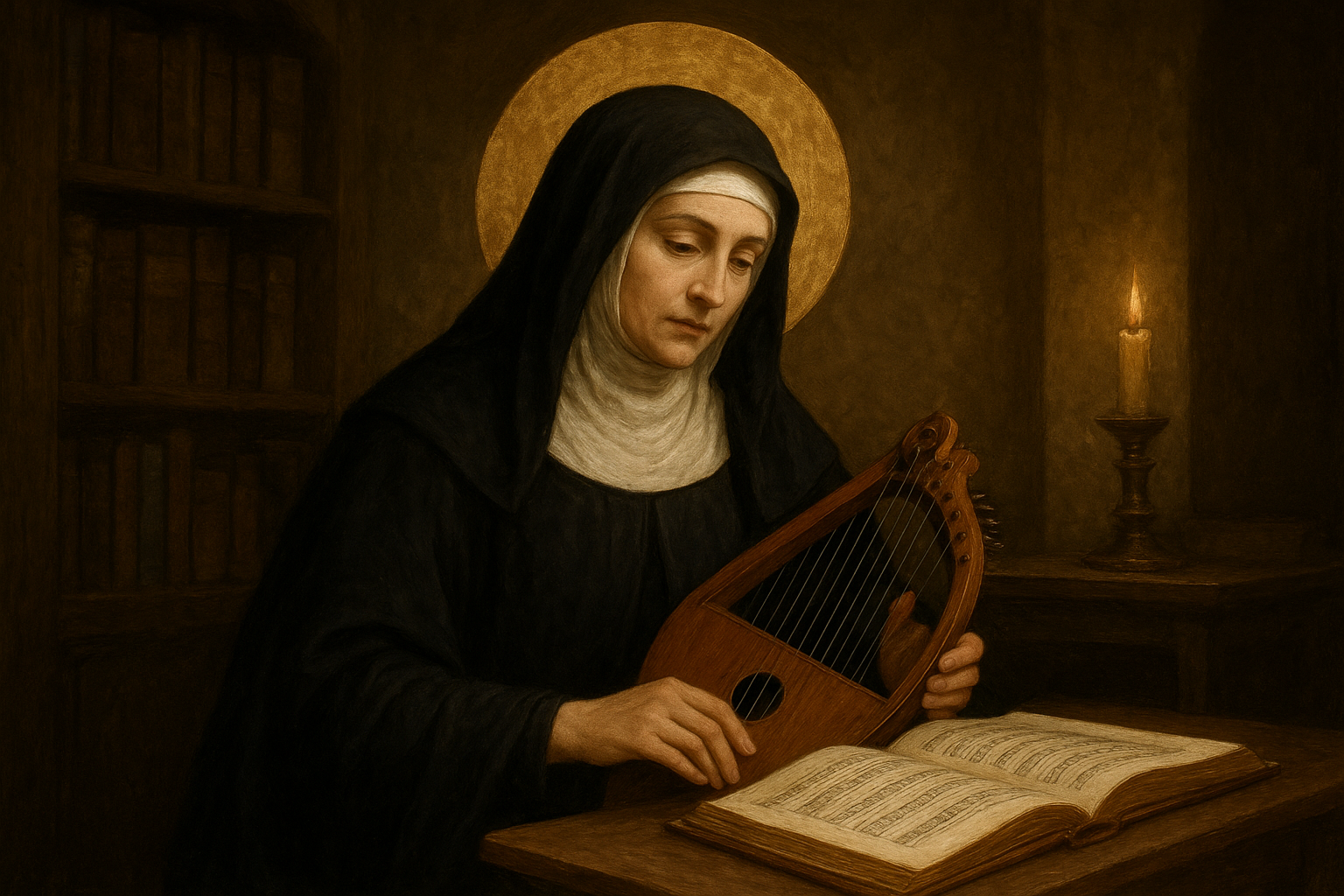
The Middle Ages, often characterized as a period of darkness and ignorance, is, in truth, a fascinating epoch of profound spiritual and cultural evolution. Among the luminaries of this era stands Hildegard of Bingen (1098–1179), a polymath who not only contributed to the development of Western music but also left an indelible mark on theology and mysticism.
Early Life and Spiritual Awakening
Hildegard was born into a noble family in the Rhine region of what is now Germany. From a young age, she reported experiencing intense visions, which she later described in her work Scivias. Her religious and mystical insights foreshadowed her later life as a Benedictine abbess, theologian, and composer. According to Hildegard, these visions were divine revelations. As she famously wrote, they came from “the living Light,” filling her with a transformative clarity and purpose.
Music: A Heavenly Harmony
Hildegard’s contributions to music are profound and pioneering. Her compositions, characterized by soaring melodies and ethereal beauty, were revolutionary for their time. She penned over 70 works, including the liturgical drama Ordo Virtutum. Unlike the more formulaic Gregorian chants, her music embraced a broader range, reflecting the transcendent qualities of her visionary experiences.
“I heard a voice from heaven saying to me, ‘Cry out therefore, and write thus.’” – Hildegard of Bingen
Theology and Mysticism
Hildegard’s theological writings delve deep into divine and earthly symbiosis, where she blended mystical experiences with a profound understanding of the cosmos. Her works, such as Physica and Causae et Curae, explore medicine and natural science, demonstrating her belief in the interconnectedness of all creation.
- Scivias: Hildegard’s principal work, including 26 visions, illustrating her understanding of God and the universe.
- Ordo Virtutum: One of the earliest known morality plays, encompassing themes of virtue and the soul’s journey.
- Symphonia: A collection of her musical compositions that have been hailed for their originality and depth.
Legacy and Impact
Declared a Doctor of the Church in 2012, Hildegard’s legacy persists in her profound vision of a universe filled with divine light. Her music continues to be performed worldwide, captivating audiences with its timeless beauty and depth. Through her works, Hildegard invites a reflection on the mystical dimensions of life and the harmony of creation.
You can learn more about Hildegard’s life and works at the Encyclopædia Britannica.
In both her music and writing, Hildegard of Bingen offers a rich tapestry of insight that bridges the medieval and modern worlds, inviting seekers of wisdom to explore the profound unity between the divine and the earthly.