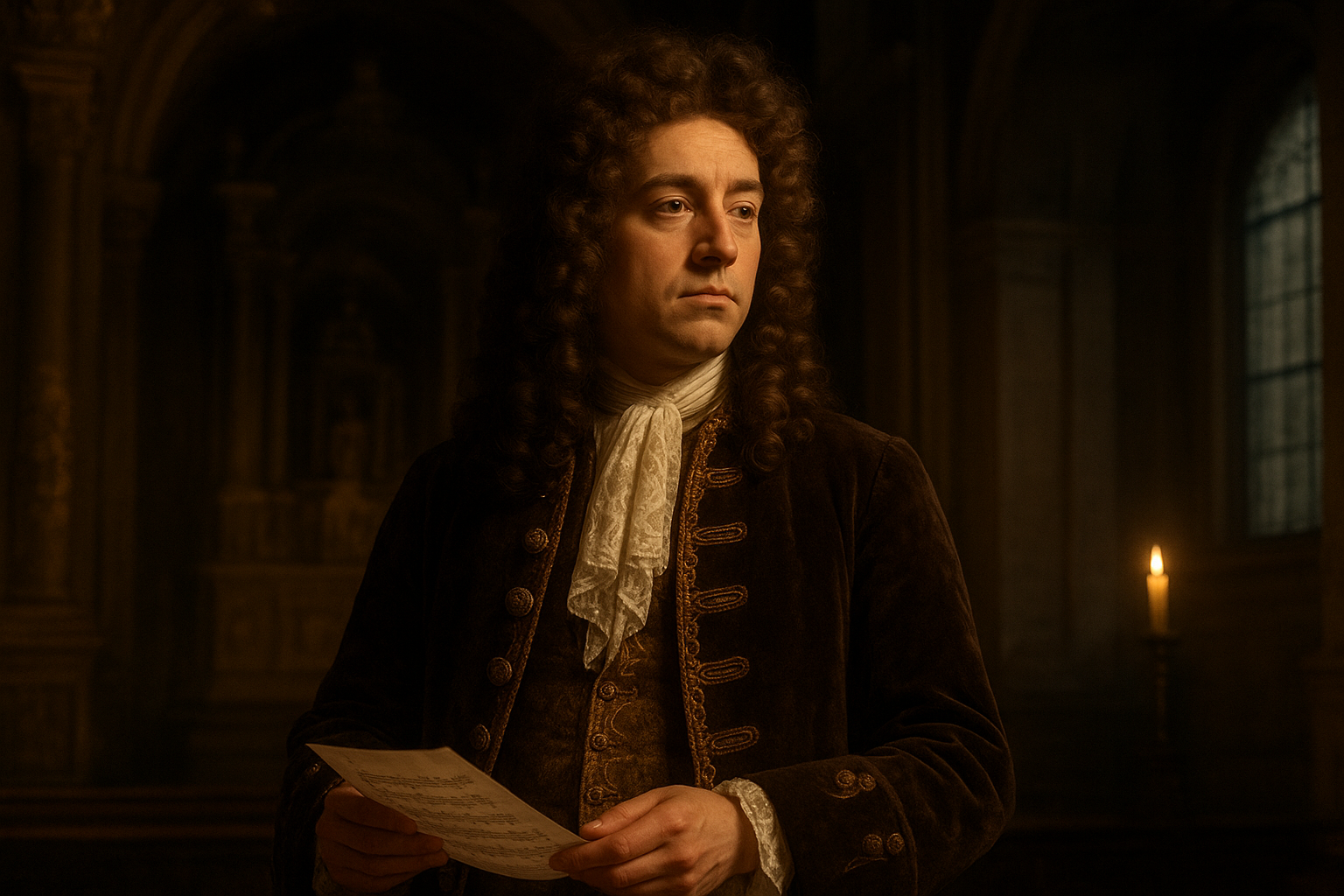
Purcell’s English Voice: Baroque Brilliance in Theater and Church
Henry Purcell, often hailed as England’s greatest Baroque composer, remains a pivotal figure whose music elegantly bridges the realms of theater and church in late 17th-century England. Born in 1659, Purcell’s work exemplifies the rich, expressive possibilities of the Baroque era, infused with a uniquely English voice.
Musical Innovation in the Theater
Purcell’s contribution to dramatic music, notably through his operas and semi-operas, highlights his skill in blending music with narrative. His most famous stage work, Dido and Aeneas, is a masterpiece of operatic form. Premiering in 1689, it contains the haunting aria “When I am laid in earth,” which underscores Purcell’s ability to convey profound emotion through music.
“No composer before him ever caught the English hues of speech so surely. His melodies are often founded upon the common inflections of English speech.” – Sir John Eliot Gardiner (The Guardian)
- Dido and Aeneas: An opera in miniature, it illustrates Purcell’s flair for drama and musical storytelling.
- The Fairy-Queen: Based on Shakespeare’s A Midsummer Night’s Dream, this semi-opera showcases diverse musical forms and Purcell’s inventiveness in theatrical music.
Church Music: A Sacred Legacy
Beyond the theater, Purcell’s church compositions significantly impacted English sacred music. His anthems and service music demonstrate a masterful use of counterpoint and harmony, blending the solemnity essential to sacred settings with an approachable lyrical beauty.
- Anthems: Works such as “Hear My Prayer, O Lord” reveal his adept use of vocal textures to evoke spiritual depth.
- Funerary Music: Composed for the funeral of Queen Mary II, these pieces, including his famous Funeral Sentences, are poignant examples of Baroque choral writing.
Purcell’s untimely death in 1695 at the age of 36 curtailed a career that had already left an indelible mark on both theatrical and sacred music. His oeuvre remains celebrated for its melodic grace, rhythmic vitality, and innovative fusion of English and European musical traditions.
Today, Henry Purcell is remembered not only as a quintessentially English composer but as a Baroque master whose works continue to inspire performers and delight audiences worldwide.