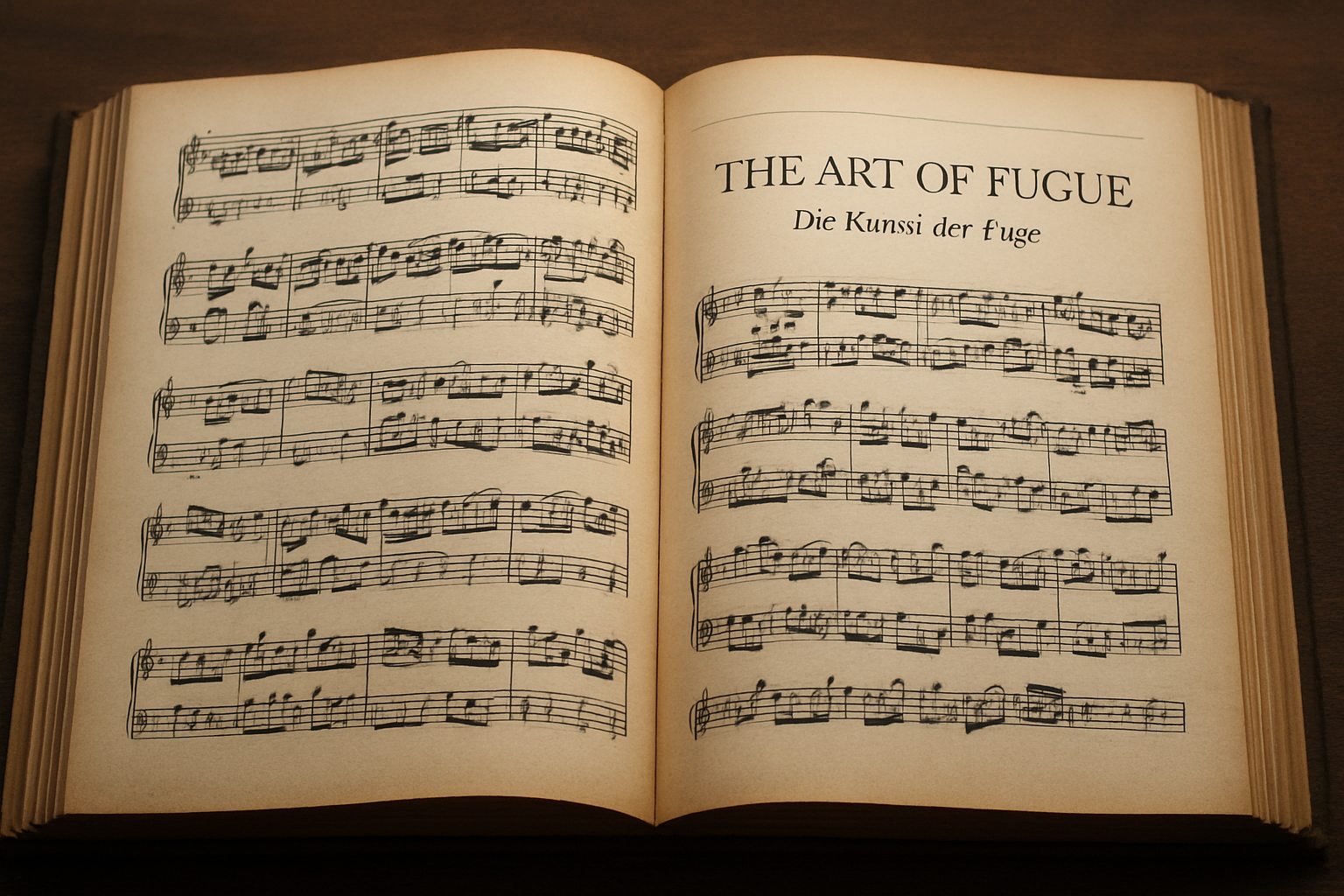
The Art of the Fugue: Contrapuntal Mastery in Bach’s Scores
The work of Johann Sebastian Bach is celebrated for its complexity, depth, and the sheer artistry that it encapsulates within the world of classical music. Among his prolific output, The Art of the Fugue (Die Kunst der Fuge) stands as a pinnacle of contrapuntal mastery. Composed in the final decade of Bach’s life, this collection of fugues and canons offers an unparalleled glimpse into the masterful melding of mathematical precision and expressive music.
The Structure of Perfection
The Art of the Fugue is distinctive in its approach to counterpoint—the art of combining different melodic lines in a musical piece. What sets this work apart is its singular thematic foundation: a main fugue subject that is manipulated to explore a vast range of contrapuntal possibilities. As the music scholar Christoph Wolff notes, “Bach himself almost certainly also intended the individual settings to be understood in multiple ways—both ‘aurally’ and intellectually” (Bach-Cantatas).
A Legacy of Intricacy and Innovation
The pieces in The Art of the Fugue are presented in increasing order of complexity, featuring 14 fugues and 4 canons. Interestingly, Bach left the work unfinished; the last fugue, among the most intricate, breaks off before completion. Some speculate this abrupt end symbolizes Bach’s own life, concluding suddenly yet leaving an indelible mark.
In terms of its construction, the work employs a “musical code,” a kind of intellectual puzzle that continues to fascinate and challenge musicians and scholars alike. As musician Charles Rosen referenced, the music of Bach requires “not only a grammatical but a dramatic sense to resolve the technicality into a deeper sense of human feeling” (The New York Review).
Modern Resonance
Despite being over two centuries old, The Art of the Fugue remains highly influential in classical music. It continues to be a source of study for musicians looking to grasp the intricacies of counterpoint. Conductors, musicians, and composers like Glenn Gould, Leonard Bernstein, and Pierre Boulez have all regarded Bach’s work as paramount in shaping the musical landscape.
“The Art of the Fugue is an exercise in musical architecture and philosophy,” writes musicologist Paul Griffiths. “Its universal design has inspired generations, opening musical dimensions unimaginable before its conception” (The Guardian).
Ultimately, The Art of the Fugue is much more than a theoretical work; it is a testament to Bach’s unparalleled ability to weave complexity and beauty into a holistic masterpiece that transcends time and continues to enchant audiences worldwide.