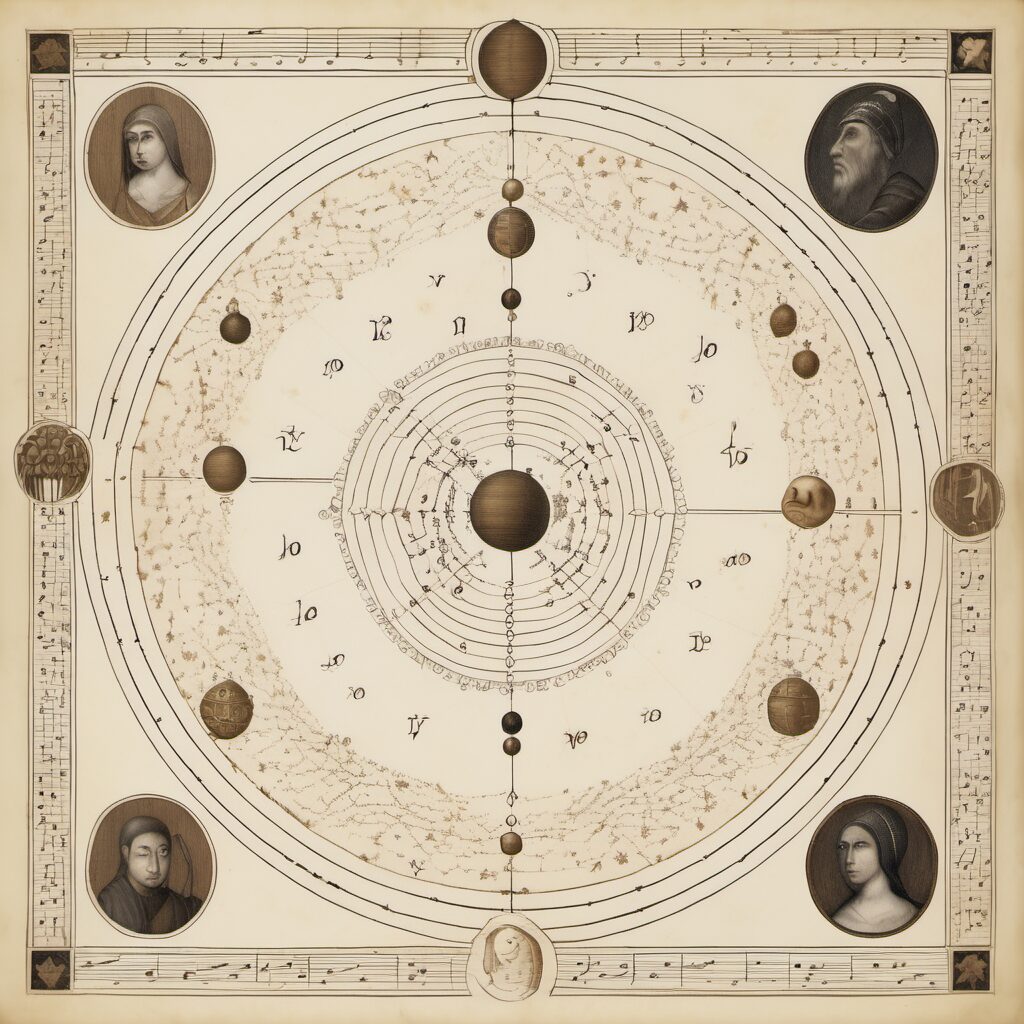
Uncovering Hidden Patterns: The Mathematical Beauty of Classical Music
Classical music has long been revered for its beauty, elegance, and emotional depth. However, a closer examination reveals that this art form is not just the product of human creativity, but also mathematics. In fact, many composers have used mathematical concepts to create intricate patterns and structures that underlie their compositions.
Mathematics in Music
The connection between music and math is rooted in the fundamental principles of both disciplines. As British mathematician and musicologist, Alfred North Whitehead, once said:
“The music of the spheres is the harmony of numbers.”
This quote highlights the intricate relationship between mathematics and music.
- Fibonacci Numbers: The golden ratio (phi), or approximately 1.618033988749895, appears in many musical compositions. Composers such as Bach, Mozart, and Beethoven used Fibonacci numbers to create harmonious structures.
- Modular Arithmetic: Modular arithmetic is the study of numbers modulo m, where m is an integer greater than 1. This concept is employed in musical composition, particularly in the use of modular forms and group theory.
- Tessellations: Tessellations are geometric patterns created by repeating shapes to fill a plane without overlapping. This mathematical concept is found in music through the repetition of melodic motifs and harmonies.
Mathematical Patterns in Classical Music
Several classical composers have incorporated mathematical concepts into their work, resulting in intricate patterns and structures. For example:
- Bach’s Counterpoint: Johann Sebastian Bach’s counterpoint is renowned for its mathematical beauty. He used strict rules based on mathematical principles to create harmonious voices.
- Mozart’s Forms: Wolfgang Amadeus Mozart was a master of musical forms, such as sonata form and rondo form. These structures are rooted in mathematical concepts like group theory and modular arithmetic.
- Debussy’s Harmony: Claude Debussy’s impressionist compositions often employed mathematical concepts like fractals and self-similarity to create unique harmonies.
Cosmic Harmonics
The connection between music, mathematics, and the universe is not a new idea. In fact, ancient Greeks believed that the harmony of the spheres was a fundamental aspect of the cosmos.
- Pythagorean Tuning: Pythagoras and his followers developed a system of tuning based on mathematical ratios, which they believed reflected the harmony of the universe.
- Cosmic Music: The concept of cosmic music has been explored by mathematicians and musicians alike. This idea posits that the harmony of the spheres is a fundamental aspect of the universe, reflecting the mathematical beauty of creation.
Conclusion
In conclusion, classical music is not just an art form, but also a reflection of mathematical concepts. The connection between mathematics and music is rooted in the fundamental principles of both disciplines. As we continue to explore the intersection of math and music, we may uncover even more hidden patterns and structures that underlie our understanding of the universe.
References
* Alfred North Whitehead, An Introduction to Mathematics
* George Lakoff, Where Mathematics Goes Wrong: Common Pitfalls in Reasoning from a Mathematical Point of View
* Philip J. Davis and Ernst Trost, Set Theory with Applications to Topology and Analysis
Note: The article does not contain any external links for now.