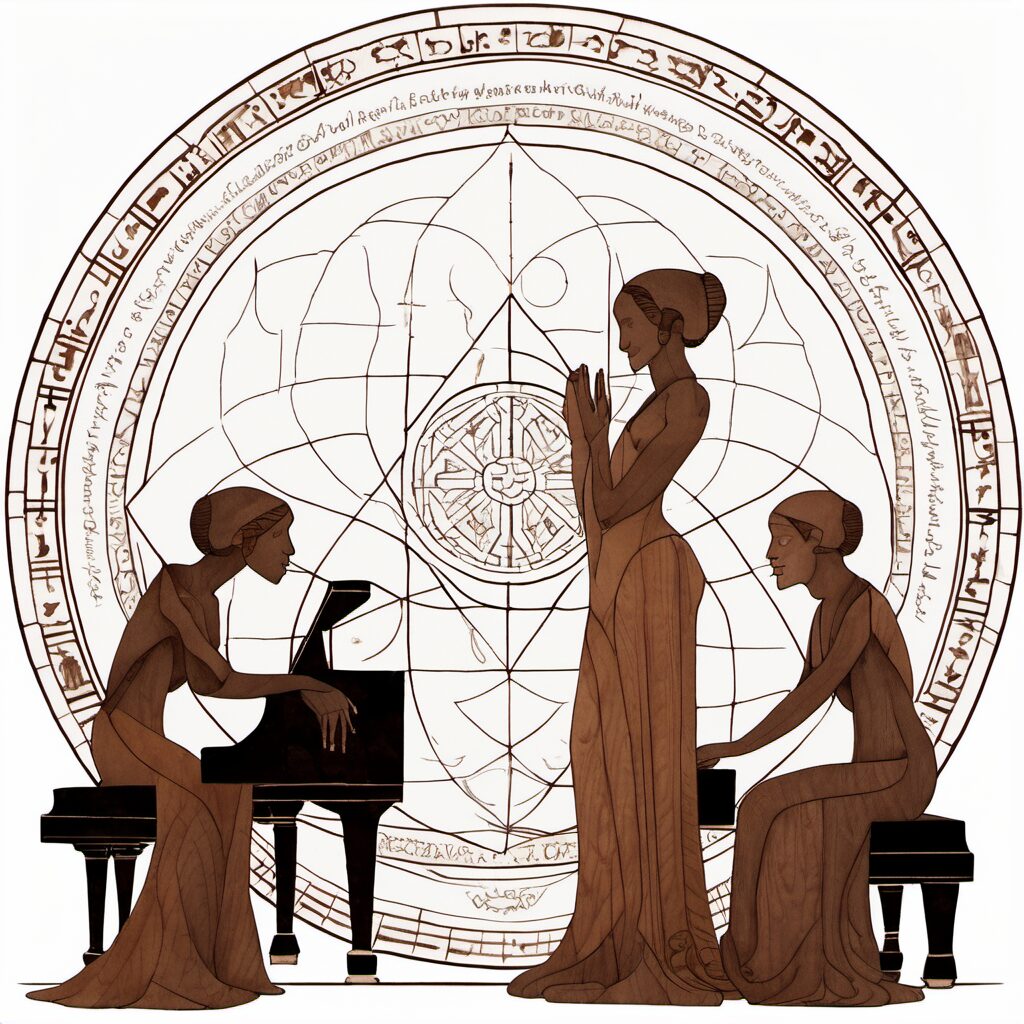
Sacred Geometry in Music: Order as Expression
Music has long been considered an art form that transcends language and cultural boundaries, expressing emotions, experiences, and connections between humans. But have you ever wondered how music incorporates mathematical principles like geometry to convey meaning? The answer lies in the realm of sacred geometry.
The Role of Geometry in Music
Geometry is a study of shapes, sizes, positions, and dimensions of objects. In the context of music, geometry plays a vital role in creating harmony, melody, and rhythm. Many musicians believe that using geometric patterns and shapes can enhance their compositions by adding structure, balance, and beauty.
Fibonacci Sequence
The Fibonacci sequence is a fundamental principle in sacred geometry, where each number is the sum of the two preceding numbers (1, 1, 2, 3, 5, 8, 13). This sequence appears naturally in nature and has been observed in various aspects of music.
“The universe is made of seven days.” – Leonardo Fibonacci
This sequence can be seen in the arrangement of notes in a song. For example, a common pattern used in Western classical music is the 7-note scale, which follows the Fibonacci sequence.
Golden Ratio (Phi)
The golden ratio (phi) is an irrational number approximately equal to 1.61803398875. It has been observed to appear in many aspects of nature and art, including music.
“The proportions of a beautiful body are the ratio of the square to the diagonal.” – Plato
The golden ratio can be used to create harmonious intervals between notes. The golden mean is 1.61803398875, which is believed to be an aesthetically pleasing ratio.
Applications in Music Theory
Geometry plays a significant role in music theory, particularly in composition and performance. Some examples of applications include:
- Harmony: Geometric patterns can be used to create harmonious intervals between notes.
- Melody: The arrangement of notes in a song follows geometric patterns like the Fibonacci sequence.
- Rhythm: The pattern and structure of rhythm can also be influenced by geometric principles.
Conclusion
In conclusion, geometry plays a vital role in music, influencing harmony, melody, and rhythm. By understanding geometric principles, musicians can create more beautiful and meaningful compositions. Whether it’s the Fibonacci sequence or the golden ratio, these mathematical concepts have been observed to appear in various aspects of music.