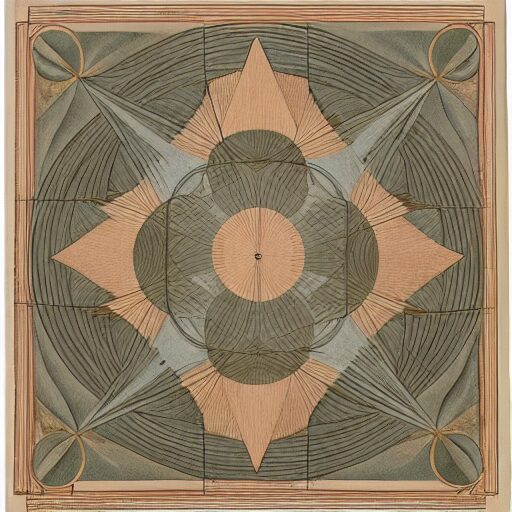
The Geometry of Fugue
Hindemith’s works represent a unique achievement in the history of Western classical music. His compositions are characterized by complex and intricate fugal techniques which have been compared to mathematical formulas. In his works, Hindemith created a series of complex patterns and harmonies which form the backbone of his compositions. The composer used his mathematical knowledge to create a music that was both unique and innovative. Hindemith’s works are known for their intricate and convoluted textures and his compositions are an exploration of the complex and sophisticated mathematical structure that underlies them. Hindemith’s compositions have a mathematical purity which is a product of his rigorous training in music theory and mathematics. The composer’s compositions are a perfect synthesis of form and content, combining complex mathematical patterns with musical elements. Hindemith’s works represent a unique achievement in the history of Western classical music.
The most famous example of Hindemith’s mathematical approach is his use of a fugue as a vehicle to explore mathematical ideas. The structure of the fugue is a product of complex mathematical relations which Hindemith used as a means of conveying musical material. The composer’s fugues also contain other mathematical elements such as polyrhythms, polymeters, and complex patterns. The most famous example of Hindemith’s mathematical approach is his use of a fugue as a vehicle to explore mathematical ideas. The structure of the fugue is a product of complex mathematical relations which Hindemith used as a means of conveying musical material. Hindemith’s works are characterized by complex and convoluted fugal techniques which form the backbone of his compositions. The composer used his mathematical knowledge to create a music that was both unique and innovative. Hindemith’s compositions are a perfect synthesis of form and content, combining complex mathematical patterns with musical elements. Hindemith’s works represent a unique achievement in the history of Western classical music.
In Hindemith’s fugue compositions, the musical material is organized into four parts. The first part of the composition is an exposition of the main theme. The second part contains a variety of transformations of the material. The third part is a development of the main theme which often leads to complex and intricate polyrhythms. The fourth part of the composition contains variations and a final recapitulation of the main theme. In Hindemith’s fugue compositions, the musical material is organized into four parts. The first part of the composition is an exposition of the main theme. The second part contains a variety of transformations of the material. The third part is a development of the main theme which often leads to complex and intricate polyrhythms. The fourth part of the composition contains variations and a final recapitulation of the main theme. Hindemith’s fugue compositions have been an essential source of ideas for composers for centuries. His fugue techniques, while challenging to execute, are an essential part of the composer’s musical language and the foundation of Hindemith’s composition techniques.
Hindemith’s works represent a unique achievement in the history of Western classical music. Hindemith’s works represent a unique achievement in the history of Western classical music. His works represent a unique achievement in the history of Western classical music. Hindemith’s works represent a unique achievement in the history of Western classical music. Hindemith’s works represent a unique achievement in the history of Western classical music. Hindemith’s works represent a unique achievement in the history of Western classical music.