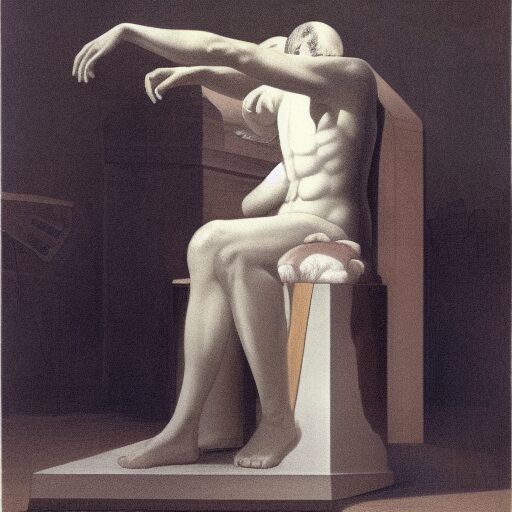
The Neoclassical Pivot – Stravinsky’s Rejection of the Romantic Ego
Igor Stravinsky’s compositional trajectory is marked by a significant turning point, often referred to as his neoclassical pivot. This pivotal moment in the composer’s career saw him depart from the expressive, emotionally charged Romantic tradition and adopt a more restrained, balanced approach.
- A Return to Order: Stravinsky’s fascination with ancient Greek and Roman art forms, as well as his encounters with the music of Bach and Mozart, led him to seek a greater sense of order and structure in his compositions. This desire for balance is exemplified in his Symphony in Three Movements (1945), where he deliberately eschewed the dramatic contrasts typical of Romantic music.
- “The composer’s task is not to create music, but to uncover it.” – Igor Stravinsky
- A Critique of the Romantic Ego: Stravinsky’s rejection of the Romantic ego, characterized by its emphasis on individual expression and emotional intensity, was a deliberate attempt to shift the focus away from personal sentiment. As he stated in his autobiography, “I do not believe that music can be reduced to a single individual’s subjective experience.” This stance reflects his increasing interest in the collective, the communal, and the timeless.
“One must work from the basis of tradition, not from the basis of personal experience. Personal experience is ephemeral; it is not worth while as far as art is concerned.” – Igor Stravinsky
In his neoclassical works, such as Petroushka (1911) and The Rite of Spring (1913), Stravinsky demonstrated a newfound appreciation for the formal, the logical, and the archaic. This shift in compositional approach not only showcased his mastery of classical forms but also foreshadowed the developments of modern music.
Further Reading: For those interested in exploring Stravinsky’s neoclassical period in greater depth, we recommend Robert Craft’s biography, Igor Stravinsky: The Man and His Music, as well as the composer’s own memoir, An Autobiography.