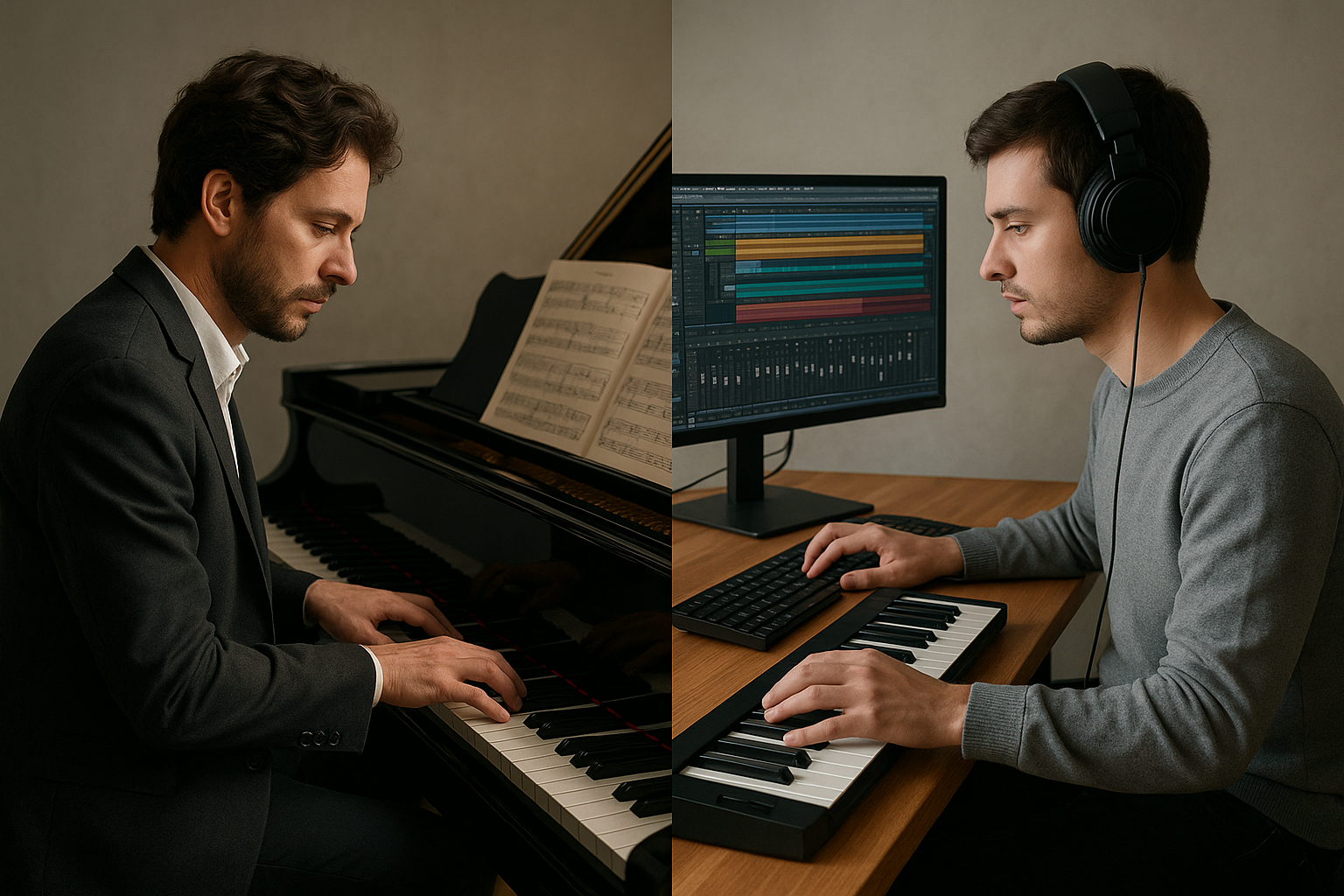
The transition from traditional to digital in the realm of music composition marks a pivotal moment in the history of music. This evolution, mirroring the broader technological advancements of the 20th and 21st centuries, has expanded the horizons of what it means to be a composer.
The Traditional Roots
The role of a composer has always been to breathe life into music through craftsmanship and creativity. Historically, this process was deeply rooted in the physical act of playing an instrument, with the piano often serving as the primary tool for composition. Using pen and paper, composers scribbled complex arrangements that orchestras would bring to life. As Igor Stravinsky astutely remarked, “The principle of true art is not to portray, but to evoke.” The tactile sensation of the piano keys was central in this evocative process.[1]
Digital Transformation
With the advent of the digital age, the landscape of music composition has undergone a seismic shift. The introduction of synthesizers, digital workstations, and software like Logic Pro and Ableton Live has redefined the tools available to composers. These technological advancements have opened new avenues for musical experimentation and creation. In a world where anyone with a computer can access virtual instruments, the barriers to entry for aspiring composers have decreased significantly.
The Rise of the Home Studio
One of the most significant developments in recent years is the rise of the home studio. Thanks to high-quality recording software and accessible online tutorials, composers can produce music that rivals professional recordings without ever leaving their rooms. Brian Eno famously stated, “The studio itself is a musical instrument.”[2] This sentiment reflects the changing nature of music production, where the studio, enhanced by cutting-edge software, allows for limitless sonic exploration.
Beyond Human Creativity
The incorporation of Artificial Intelligence (AI) in music composition marks the latest chapter in this technological evolution. AI tools can now assist in creating compositions, suggesting chords or even generating entire pieces based on certain inputs. While some purists may view this with skepticism, the integration of AI into music composition offers unprecedented collaboration between human creativity and machine efficiency.
“A future where machines become part of your composition process is not distant. They can offer new perspectives and inspiration,” as discussed in The Guardian.
The evolution from piano to processor is not merely a transformation in tools but represents a broader shift in how composers think about and interact with music. This ongoing journey challenges traditional notions of music creation and keeps the art form excitingly dynamic.