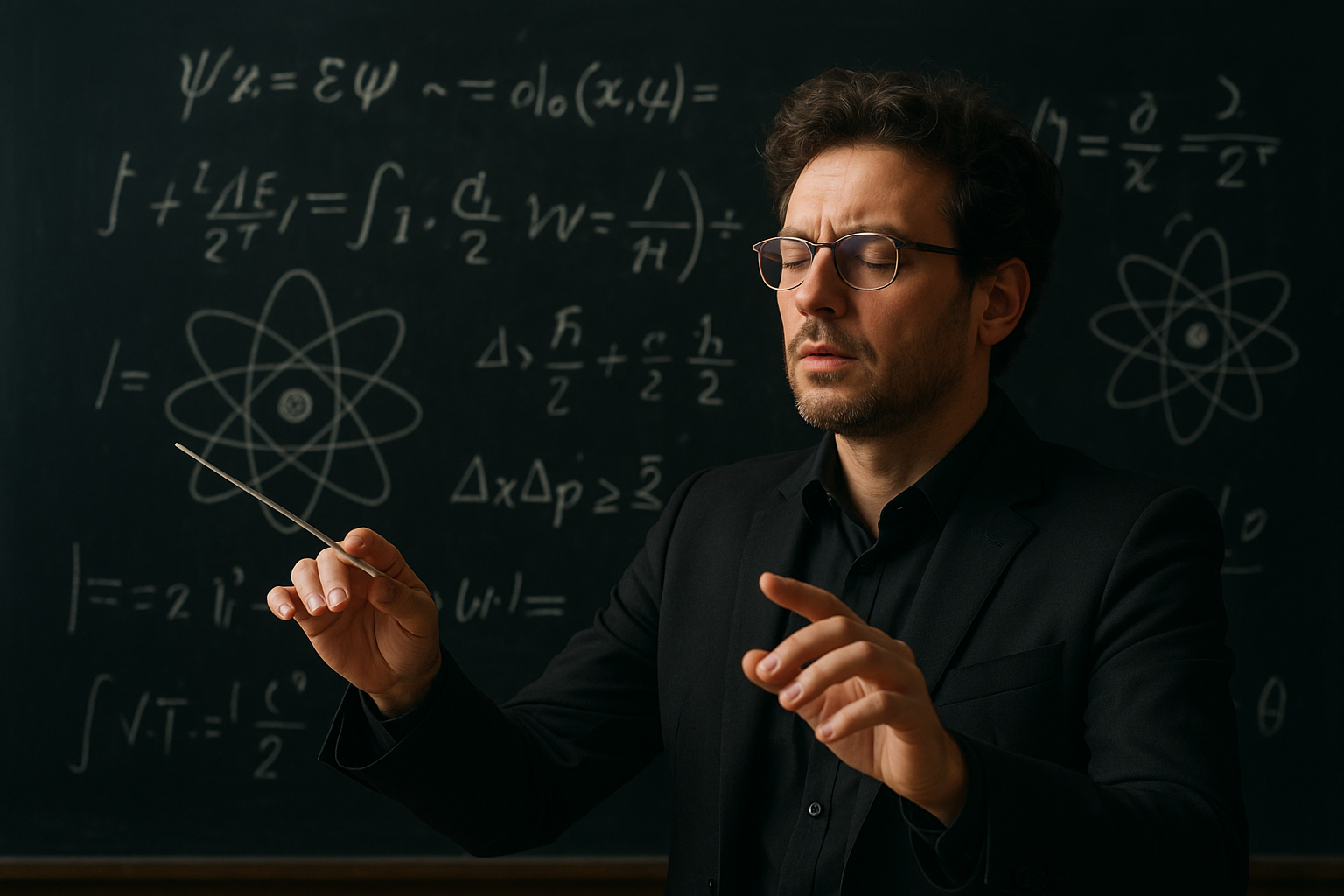
The Quantum Fugue: Theoretical Physics Inspiring Modern Composition
At the intersection of science and art, the realms of theoretical physics and musical composition are more intertwined than one might initially imagine. Known for its brilliant complexities, theoretical physics provides a profound source of inspiration for modern composers. This fusion of disciplines, where quantum theories meet melodic constructs, is leading to a new wave of creative works that could be aptly described as a “Quantum Fugue.”
A Brief Overview of Theoretical Physics
Theoretical physics seeks to fully explain and link the laws of the universe. It involves deep abstract thought processes to construct models that simulate the natural world. Concepts such as quantum mechanics, relativity, and string theory define this field, posing puzzles about the very fabric of reality, time, and space.
“I think science is very analytical, and music is physical and emotional,” said physicist Brian Greene. “But in music—like physics—you start with an idea that becomes beautiful. They are expressions of the same sensibility.”
It’s this sense of beauty, symmetry, and interconnectedness found in theoretical physics that composers are beginning to explore more profoundly in their works.
The Music of the Spheres: Historical Influences
The concept of linking music and the sciences is not new. Historically, the ancient Greeks conceived the “Music of the Spheres,” a philosophical idea that regarded the movements of celestial bodies as a form of music, inaudible but perfectly harmonious.
In the modern age, physics and music have been particularly intertwined since the early 20th century, with Einstein himself an accomplished violinist. The intriguing relationship between these fields persists, with more artists finding inspiration in contemporary scientific developments.
Modern Composers and Quantum Inspiration
Today’s composers often draw directly from advances in physics. Some renowned artists have taken quantum states or cosmological phenomena and transformed them into auditory experiences.
- Philip Glass: Known for his minimalist style, Glass frequently incorporates ideas from science into his compositions. His opera Einstein on the Beach is a classic example of science inspiring music.
- John Adams: Another composer influenced by physics, Adams produced the piece Harmonielehre, which captures the turbulence and elegance of large celestial bodies.
The Quantum Approach
An aspect of quantum mechanics that greatly attracts composers is its representation of uncertainty and superposition. The ways in which particles can exist in multiple states at once, yet none until observed, may be analogous to music’s potential—the many ways a melody can unfold before it is heard.
Composers inspired by these concepts often play with unconventional structures, exploring non-linear forms and probabilistic outcomes in their music. These compositions may not always follow the traditional progression but rather embrace chaos and unpredictability, mirroring the indeterminate nature of quantum particles.
Bridging the Disciplines
Widgets like Particle.io allow users to generate soundscapes based on live data from particle accelerators, providing a real-time auditory experience of science. This bridges the divide between the observer and the observed, turning theoretical abstracts into palpable, sensorial realities.
Professor David R. Jones, from the University of Boston, remarked, “As our understanding of the universe expands, so too does our toolbox for creativity. Great art, like great science, often involves looking beyond the accepted, towards what might be possible.”
Conclusion: The Quantum Fugue
As science continues to push boundaries, composers find themselves with a wealth of new ideas to explore. This cross-pollination is producing a new breed of compositions that challenge listeners to engage with music in a fresh way—through the lens of modern theoretical physics.
Ultimately, the “Quantum Fugue” embodies a celebration of both disciplines, where perhaps the greatest harmony is not in the music itself, but in the shared pursuit of understanding the universe and our place within it.
For further exploration, listen to works inspired by theoretical physics or attend symposiums where scientists and musicians collaborate. Understanding the universe through the language of music offers not only enrichment but also a profound appreciation of the beauty and complexity that surrounds us.