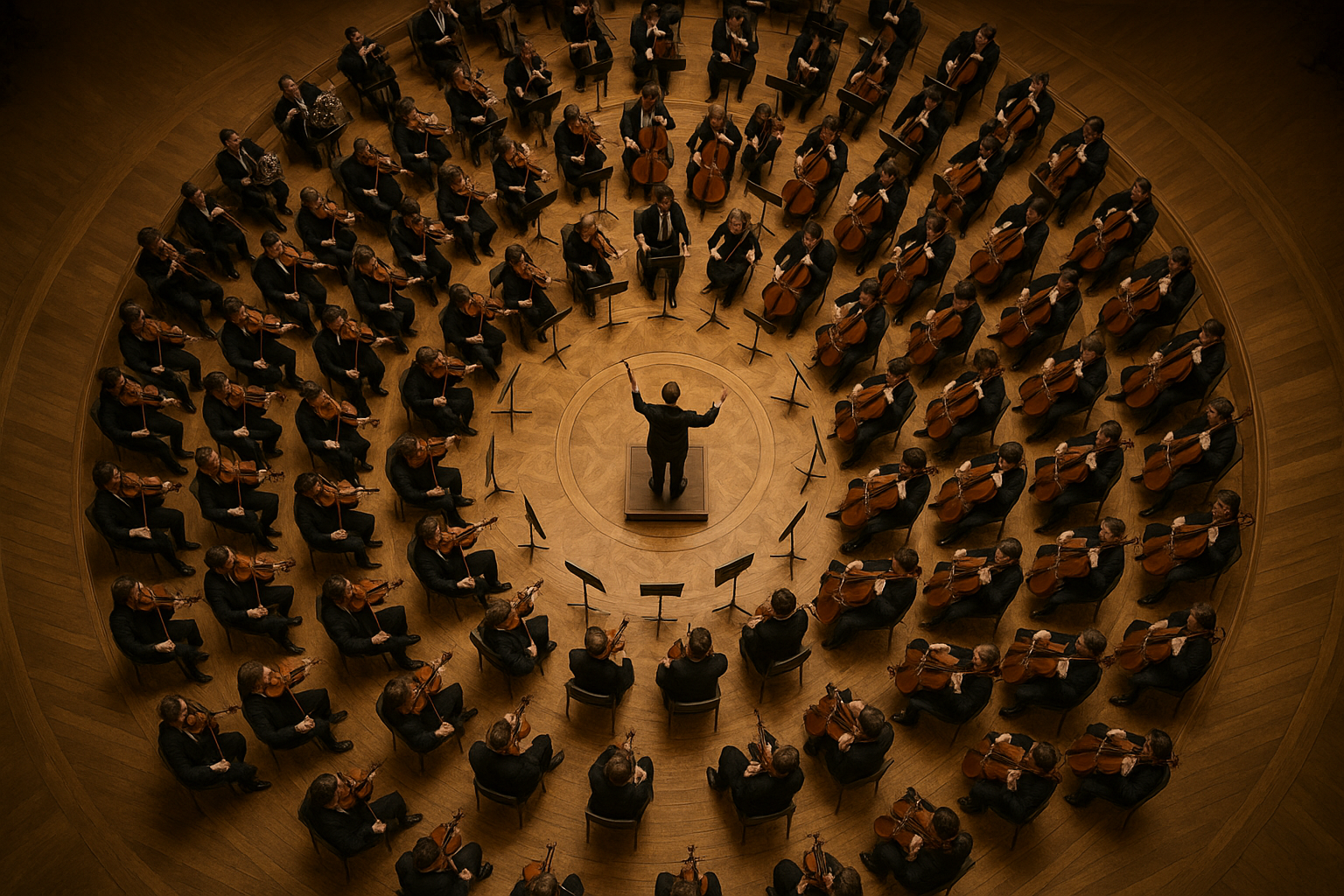
Within the vast world of music, orchestral compositions have always played a pivotal role in expressing the intricate symmetries and layered symbolism that music can embody. The notion of the “orchestral mandala” is a fascinating concept, inviting both musicians and listeners to explore the structural beauty and complex intricacies that these large musical forms offer.
Understanding the Mandala
A mandala, a Sanskrit word meaning “circle,” traditionally signifies a geometric configuration of symbols. In various religions, it represents the cosmos metaphysically or symbolically—a microcosm of the universe. Its structure often depicts the orderly nature of the cosmos, delivering a sense of unity and harmony. This concept translates seamlessly to orchestral music, where compositions frequently mirror the mandala’s circular and symmetrical properties.
Symmetry in Composition
Symmetry has long been a touchstone in music composition. In the words of Igor Stravinsky, a composer known for his groundbreaking explorations of form, “The more constraint one imposes, the more one frees oneself.” (Source: BrainyQuote). Composers often use symmetry as a tool to create balance and structure within their music, echoing nature’s own preference for symmetry seen in biological and physical forms.
Consider the classical symphony: its four movements often follow a symmetric plan, offering a journey from the opening sonata form, through a lyrical slow movement, into a minuet or scherzo, and concluding with the vigorous energy of the finale. Each segment contributes to a cohesive whole, resonating with the mandala’s symbolic journey from the center to the periphery and back again.
Unifying Themes and Motifs
Just as mandalas serve as spiritual tools in meditation or contemplation, orchestral works often embed themes and motifs that guide listeners through their structural journey. Richard Wagner’s leitmotif technique showcases this beautifully. He employed recurrent musical themes that signified characters or ideas, weaving an intricate web of symbolic meaning akin to the interlocking circles of a mandala.
“The task of the composer is to find proper expression of the infinite within finite forms.” – Gustav Mahler
Gustav Mahler, known for his expansive symphonies, embraced this challenge, crafting music replete with thematic material that echoes back upon itself. His works, such as Symphony No. 9, capture the cyclical nature of life and death, employing a rich tapestry of themes that grow, evolve, and return.
Exploring Symbolism Through Sound
Beyond mere structure, the orchestral mandala communicates through a symbolic language of sound. Each instrument contributes unique timbres, much like colors in a visual mandala. The orchestra becomes a potent vehicle for storytelling, where every crescendo, diminuendo, and harmonic shift carries symbolic weight.
In Olivier Messiaen’s Turangalîla-Symphonie, symbolism plays a pivotal role, integrating mystical and religious themes. Messiaen utilizes scales of limited transposition—musical modes that are symmetric by nature—and rhythmic cycles to convey an eternal procession, inviting listeners to transcend temporal boundaries.
The Cultural Resonance of Large Forms
Different cultures have contributed their unique perspectives to the idea of the orchestral mandala. In Western classical music, the symphonic form has long been dominant; however, Eastern influences, such as the cyclic structures in Indian ragas and talas, offer alternative approaches to symmetry and structure.
For example, in Indian classical music, the concept of raga embodies both melodic form and symbolic meaning, akin to a mandala. The cyclical patterns of tala (rhythmic cycles) mirror the repeating motifs in symphonic movements, offering a cosmic consciousness through cyclical musical meditation.
Conclusion: Embracing the Orchestral Mandala
As listeners, when we engage with orchestral music, we engage with a complex mandala of sound and meaning. Each piece invites us into its circle, an exploration of symmetry and symbolism, leading us to reflect on our own journey through the auditory landscape.
In the orchestral mandala, music becomes not only a series of notes and rhythms but a living entity—an eternal form where substance and symbol coalesce, where art reflects the inexorable dance of creation and order in the universe. As we delve into these symphonic realms, we accept the invitation to discover something profound about the world and ourselves, harmonized in perfect, resonant symmetry.