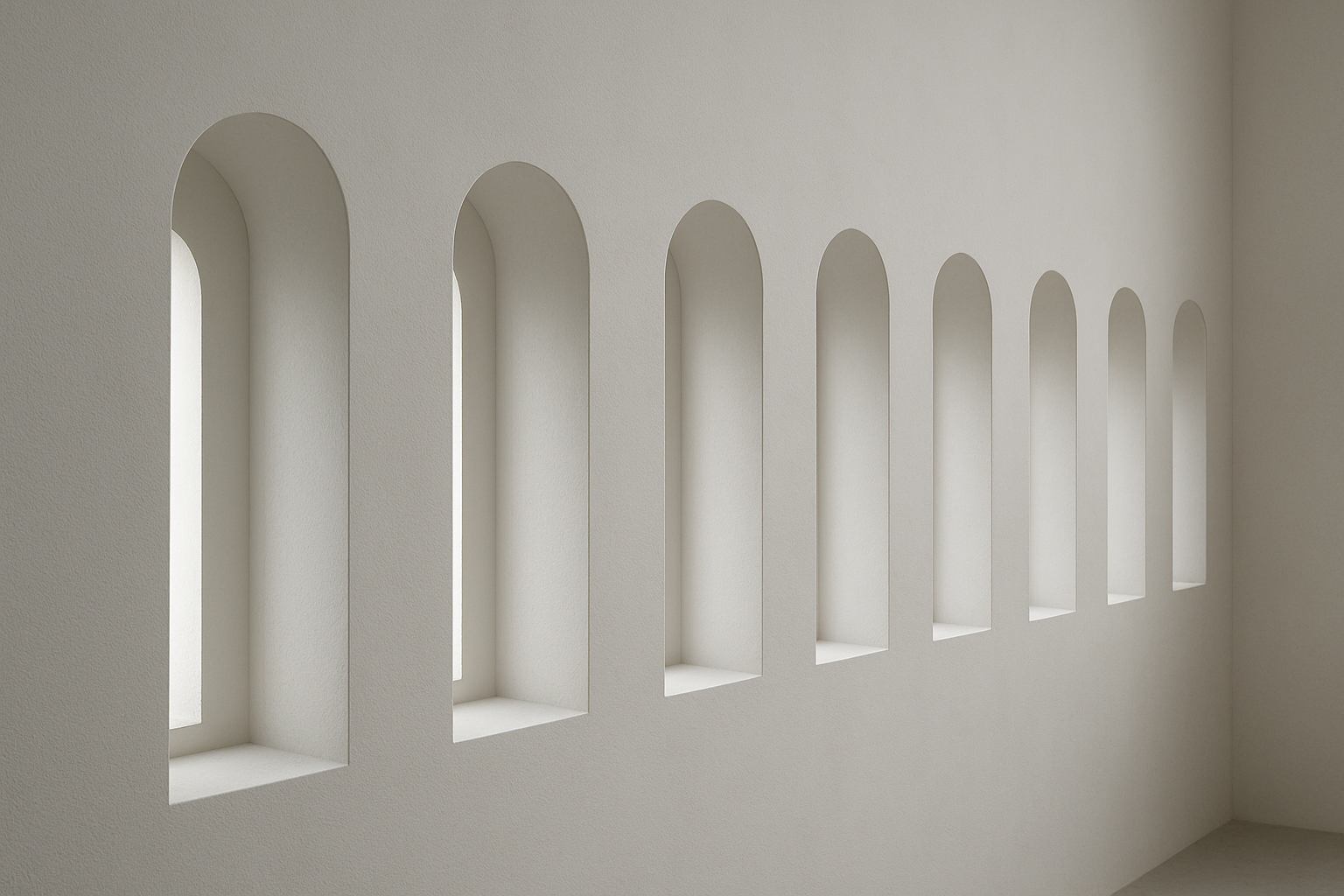
Repetition as Revelation: Mysticism Within Minimalist Process
In the realm of contemporary art, few movements have captured the intrigue and critical examination as seamlessly as Minimalism. Characterized by simplicity, order, and starkness, Minimalism invites both artists and audiences to engage in a unique visual and auditory dialogue. However, beneath its austere exterior lies an enchanting layer of mysticism that emerges through the concept of repetition. This article delves into the spiritual resonance and revelatory potential of repetition in minimalist art, exploring how it subtly transforms monotonous cycles into profound experiences.
Understanding Minimalist Repetition
The minimalist movement, which gained prominence in the late 1960s and early 1970s, emphasizes the use of simple forms and limited color palettes to distill art to its essence. At its core, Minimalism seeks to strip away the superfluous to reveal the underlying beauty of structure and form.
Repetition within minimalist art, whether in music, visual art, or literature, utilizes recurring motifs to create a meditative and immersive experience. The idea is succinctly captured by composer Steve Reich, renowned for his contributions to minimalist music. As Reich notes, “by drawing the listener’s attention to only a small amount of material, you create the possibility of experiencing more detail.”
Musical Mysticism: The Power of Reiteration
In music, repetition is not a mere compositional tool but a transformative force. Minimalist compositions strive to demonstrate how repetition can manifest as a catalyst for spiritual introspection. Music for 18 Musicians by Steve Reich is a prime example, where the persistent use of patterned rhythms and melodic fragments invokes a trance-like state in the listener.
Critics often draw parallels between Reich’s work and traditional spiritual practices. As mentioned by The Guardian, Reich has defined his style as having an affinity with African drumming and the Balinese gamelan, infusing it with the spiritual cadence found in the rituals of these cultures. The repetitive chants and cycles are akin to a mantra, drawing both musician and audience into a shared spiritual journey.
Visual Art: Minimalism Meets Mysticism
In the visual arts, repetition manifests in patterns and symmetry to evoke a quiet contemplation. Agnes Martin, a key figure in minimalist painting, used grids and lines to express what she saw as the spiritual quality of serenity and joy. Her work invites viewers to focus on perception and the nuances within the seemingly identical.
“Art is the concrete representation of our most subtle feelings,” Martin once declared, underscoring the emotional resonance found in minimalist art.
As viewers engage with repetition in her paintings, what initially seems monotonous becomes a moment of revelation. The lines blur between objectivity and spirituality, leading to a personal experience of introspection and mindfulness.
Literature and Language: Words in a Spiral
Repetition is also a crucial feature in minimalist literature, where concise prose and recurring themes lead to profound messages. For instance, the Japanese author Haruki Murakami, often lauded for his sparse yet deep style, employs repetitive motifs to explore themes of loneliness and the human condition.
In novels like Norwegian Wood or The Wind-Up Bird Chronicle, Murakami weaves cycles of events and motifs, subtly directing readers towards a deeper understanding of spiritual languor and existential searching. Through repetition, Murakami underscores the characters’ inner worlds, allowing mundane occurrences to carry a weightier, mystical meaning.
The Philosophical Underpinnings of Repetition
At the heart of repetition is a philosophical inquiry into the nature of experience and meaning. Søren Kierkegaard famously explored the idea of “repetition” or “recollection forward” in his philosophical writings. This concept alludes to the idea that true understanding and revelation come from the repetitive actions, akin to a spiral, where believers perpetually delve deeper into perception.
Kierkegaard’s exploration highlights how repetition is inherently tied to the human quest for knowledge and truth, transcending the mundane and touching the divine. Similarly, Minimalism in its various forms seeks to unlock this revelation through repetition, forcing introspection and reflection on part of the audience.
Repetition as a Spiritual Channel
The deliberate use of repetition as a channel for spiritual engagement is a testament to its profound impact. As pointed out by art critic Clement Greenberg, minimalist art by its very nature challenges the observer to abandon preconceived notions and to seek out truth in pure perception. This metaphysical perspective allows repetition to act as a conduit for spiritual awakening.
Furthermore, in an age characterized by distractions and a barrage of sensory experiences, the repetitive simplicity of minimalist art offers an oasis of calm and clarity. It beckons observers to peel back layers of the ordinary, to perceive what lies beneath the repetition and ultimately to find solace in revelation.
Conclusion: The Infinite Loop of Revelation
Minimalism thrives on the principle that less is more, and repetition is the key to unlocking its deeper insights. In its purest form, repetition becomes not just a technique, but a revelation. This mystical dimension invites both creators and viewers to engage in an infinite loop of understanding, where each experience is unique despite the sameness.
Ultimately, the symbiosis between repetition and revelation in minimalist art offers a profound insight into human perception and experience. While the journey may seem like a winding path, it is, in essence, a spiral—a manifestation of mysticism that points to an ever-deeper understanding of reality.
As Minimalism continues to influence art and culture, the repetitive forms that have become its hallmark will remain not as echoes of redundancy, but as eternal invitations to explore what lies beyond the surface—a continuous cycle of repetition as revelation.