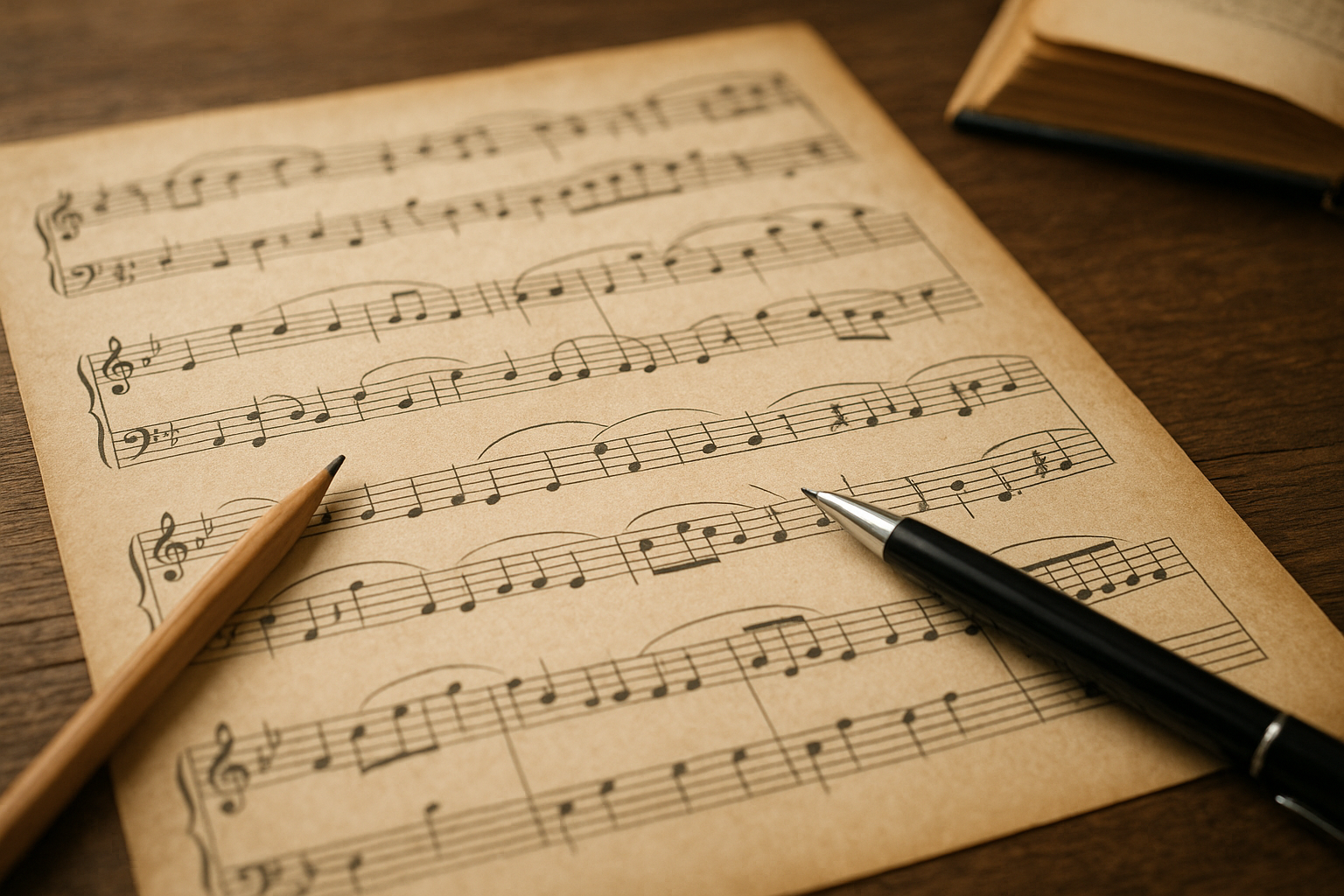
Music is often described as a universal language. Much like spoken languages, music possesses a structure and syntax that guide its composition and interpretation. This hidden grammar enables composers to craft melodies that resonate across different periods and cultures. The evolution of this compositional syntax reveals fascinating parallels with linguistic development, tracing a path from the Baroque era to contemporary times.
Baroque Elegance: The Foundations
The Baroque period (1600-1750) marked the inception of many syntactical elements that continue to influence music. Composers like Johann Sebastian Bach established complex polyphonic textures that relied on the rules of counterpoint—a sort of musical grammar for creating interdependent but independent melodies. As Douglas Hofstadter notes in his book Gödel, Escher, Bach: an Eternal Golden Braid, Bach’s work celebrated symmetry and structure, akin to the recursive nature of language.
“Bach’s music is a lucid exposition of musical syntax.” — Douglas Hofstadter
During this time, the emphasis was on voice leading and harmonic progression, providing a framework for future developments. Through intricate fugues and expansive sonatas, the Baroque era established a grammatical foundation that emphasized clarity and emotion through structured harmony.
Classical Clarity: A Precise Language
With the advent of the Classical period (1750-1820), the syntax of melody evolved toward greater clarity and simplicity. Wolfgang Amadeus Mozart and Joseph Haydn pioneered forms like the sonata-allegro, which provided a clear “grammar” for thematic development and variation. Classical music is characterized by balanced phrases and a cohesive syntax that reflects Enlightenment ideals of order and reason.
Musicologist Charles Rosen wrote, “The Classical period created a musical sentence structure that allowed emotions to be expressed with precision and elegance.” This era’s melodies exemplify the linguistic concept of periodicity, often echoing the representational symmetry found in well-composed sentences.
Romantic Expression: Expanding the Lexicon
The Romantic era (1820-1900) saw composers like Ludwig van Beethoven, Franz Schubert, and Frédéric Chopin expanding the musical grammar established by their predecessors. Romantic composers emphasized emotion, pushing the boundaries of syntax to create melodically richer, more expressive works.
Beethoven, for instance, redefined the sonata form, introducing unexpected modulations and prolonged manipulations of thematic material. This expansion is akin to a writer exploring new narrative techniques to evoke deeper emotional responses.
“Music is the shorthand of emotion,” is a phrase often attributed to Leo Tolstoy, encapsulating the Romantic ideal of melody as an emotional language without constraints.
20th Century Innovation: A New Syntax
The 20th century shattered previous syntactical norms with avant-garde movements and technological innovations. Igor Stravinsky’s unconventional rhythms and Arnold Schoenberg’s twelve-tone technique exemplify this break from tradition, creating a new grammatical framework that resembles the linguistic shifts seen in modern poetry.
Stravinsky once asserted, “The more constraints one imposes, the more one frees oneself,” highlighting a concept that resonates with contemporary composers who embrace constraints to liberate new forms of expression.
Contemporary Trends: Global Syntax
Today, the syntax of melody is more diverse and globalized than ever. Influences from jazz, pop, and world music intermingle, reflecting a society interconnected by technology and culture. John Williams, Hans Zimmer, and Philip Glass demonstrate how contemporary compositions often blend traditional symphonic structures with modern elements.
The integration of electronic music into classical forms has expanded the melodic lexicon, akin to the development of a pidgin language evolving into a creole with its nuances and complexities. As Brian Eno described it, “Music allows us to listen to time jump back, forwards, and sideways.”
The Future: Evolving Syntax
The hidden grammar of melody continues to evolve, incorporating new influences while respecting its rich lineage. As composers experiment with novel forms and technologies, the syntax of music will further transform, offering fresh ways to articulate the inexpressible.
Exploring this evolution, we gain insight into not only the changing nature of music but also our own cultural and emotional expressions. As the philosopher Friedrich Nietzsche famously remarked, “Without music, life would be a mistake,” a testament to the enduring significance of this universal language.