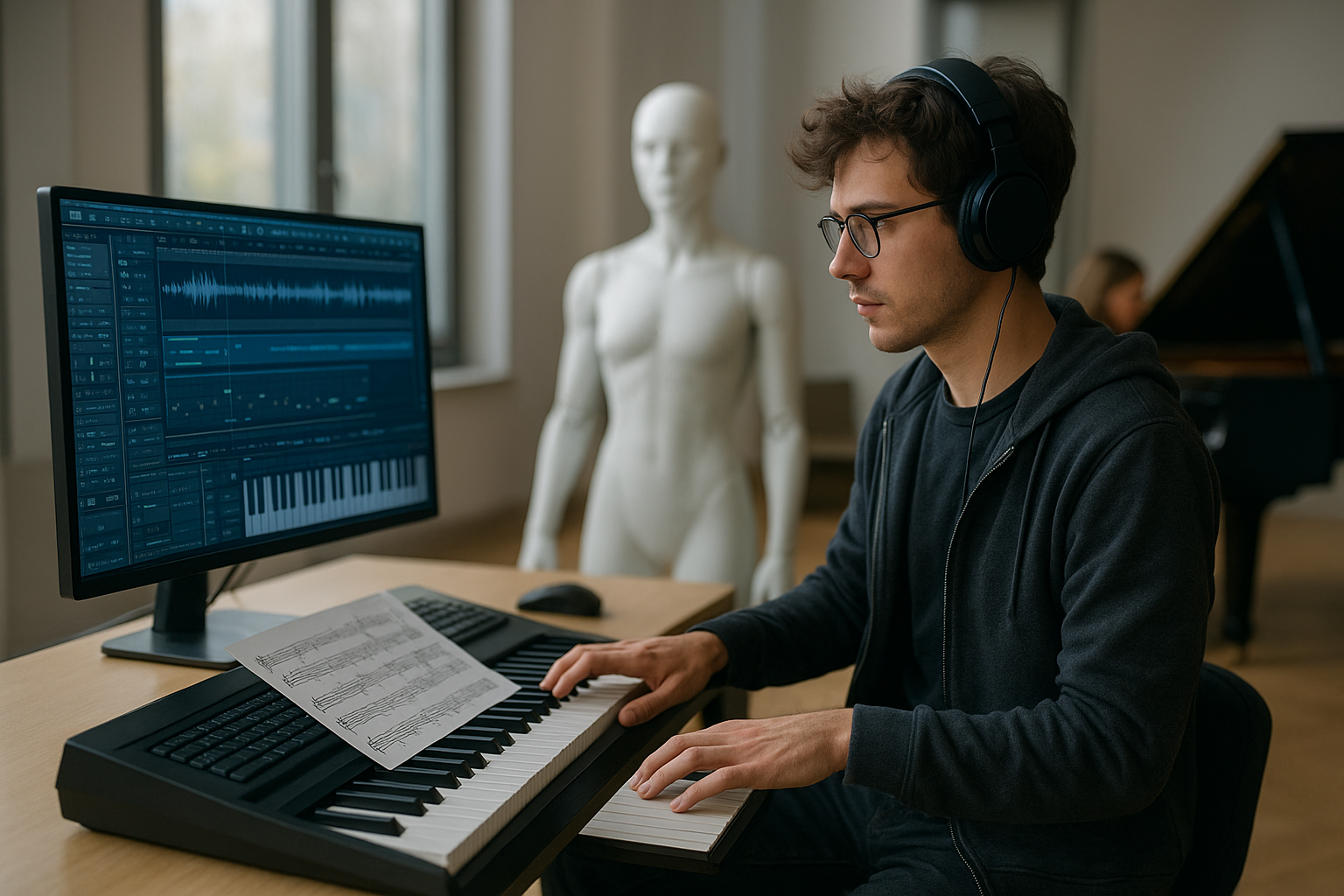
As we stand on the verge of another revolution in musical education, technology has turned the spotlight on a question that has intrigued educators and composers alike: How can artificial intelligence (AI) reshape the landscape of training the future generation of composers?
The Rise of AI in Music
Artificial intelligence is no longer a distant concept limited to science fiction. From self-driving cars to personal assistants in our smartphones, AI is ubiquitous. The music industry, too, is experiencing the profound influence of AI technologies. AI can compose symphonies, tailor music to our moods, and even collaborate with artists to create chart-topping hits. An AI called Aiva (Artificial Intelligence Virtual Artist) has been known to compose music for movies and advertising, showcasing AI’s creative capabilities.
“AI algorithms are increasingly being used to generate new music compositions, and the results are often indistinguishable from those created by human composers,” notes Dr. Emily Howell, a researcher in AI and music composition at Stanford University.
Challenges and Opportunities in Music Education
The introduction of AI in composition presents both challenges and opportunities for music conservatories. Traditionally, music education has focused on understanding the history and theory behind compositions, with a heavy emphasis on human creativity and emotion. Now, educators are tasked with integrating AI into the curriculum without losing the essence of artistic expression.
- Challenge: Balancing technology with human creativity. As AI handles technical aspects, students must focus on developing unique creative skills.
- Opportunity: Personalizing education. AI can tailor learning experiences to meet individual strengths and weaknesses, offering personalized feedback and guidance.
- Challenge: Ethical considerations in AI-generated music. Questions arise about authorship and the role of AI in creativity.
Moreover, AI’s ability to analyze vast datasets allows composers to explore styles and techniques from a variety of genres and eras, broadening their musical scope and understanding.
A New Curriculum for a New Era
To prepare future composers for a world where AI is an integral part of the music industry, conservatories must adapt their curriculums. This involves merging traditional music theory with courses in computational creativity, AI ethics, and digital music technology.
Educators are beginning to embrace this change. At the Juilliard School, initiatives are already underway to include AI-focused projects in their programs. These projects not only blend music with advanced technology but also encourage students to critically engage with the tools they use.
- Interdisciplinary Learning: A curriculum that combines music, computer science, and digital technology can empower students to utilize AI as a collaborative tool rather than a replacement for human creativity.
- Focus on Soft Skills: More than ever, soft skills like emotional intelligence, empathy, and storytelling are vital. These skills ensure that compositions resonate on a human level.
- Critical Thinking: Teaching students to critically assess AI-generated outputs encourages them to take an active role in the creative process.
The Role of Conservatories
As centers for artistic innovation, conservatories play a crucial role in guiding the ethical use of AI in music. They can foster environments where students learn to use AI responsibly, understanding its potential societal impacts. By encouraging a dialogue about the ethics of AI in music, conservatories help shape a generation of conscientious musicians who value both innovation and tradition.
“AI won’t replace composers. Instead, it will push them to grow beyond traditional boundaries of creativity and explore new possibilities,” says Antonio Lauro, head of the music technology department at Berklee College of Music.
Looking Ahead
The fusion of AI and music heralds an exciting future for composers. AI offers tools that can transform music creation, allowing composers to experiment with new sounds and structures. However, the core of music—its capacity to touch hearts and convey the depths of human emotion—will always require the human touch.
In an age where AI is set to redefine many aspects of creative practice, conservatories must adapt to prepare students for these changes. By doing so, they ensure that music remains an evolving, vibrant form of expression and that composers continue to be the heart and soul behind it.