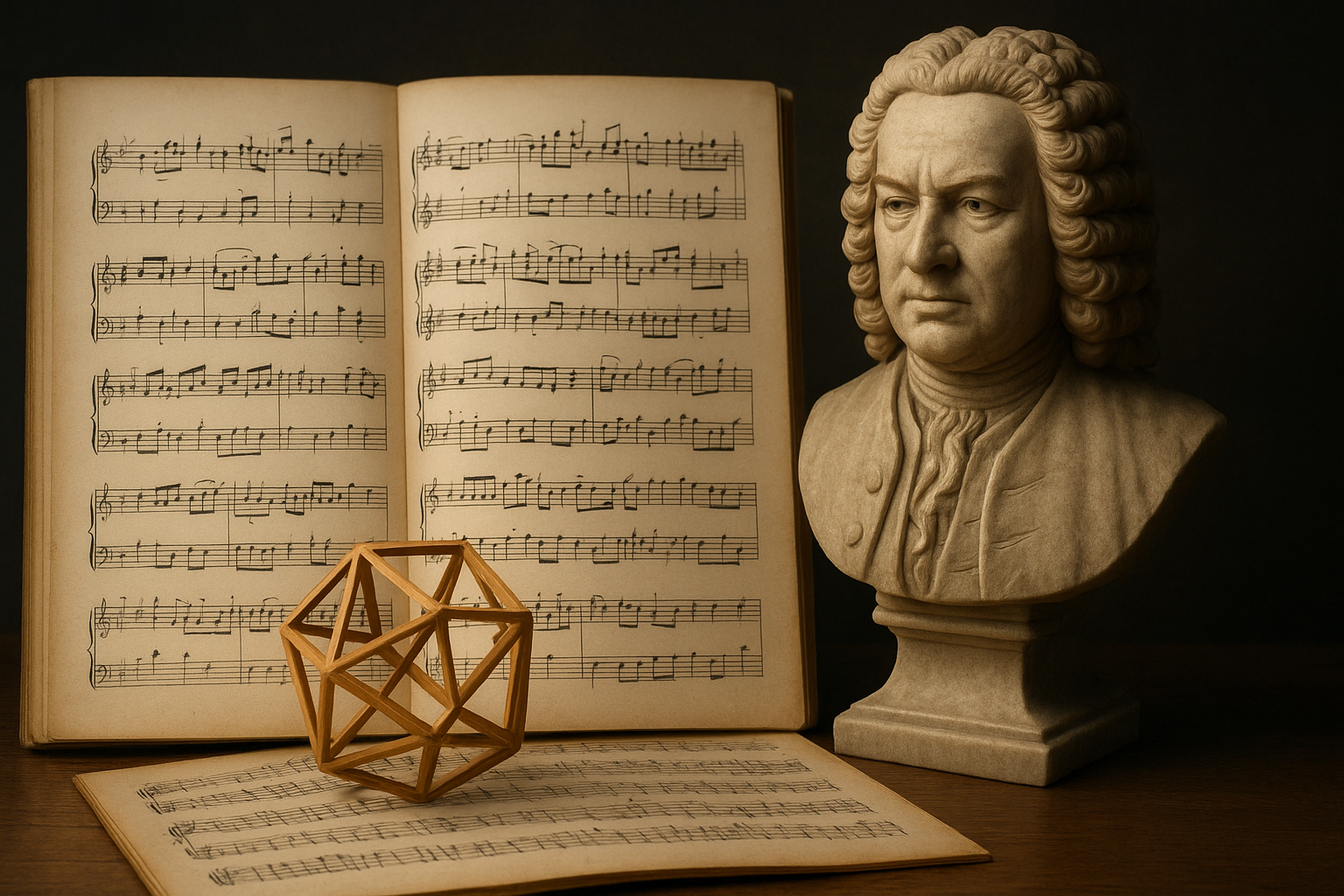
The Inner Geometry of Bach: Mathematical Spirituality in Counterpoint
Johann Sebastian Bach, the virtuoso of Baroque music, left an indelible mark on the annals of musical history with his intricate compositions. Revered for their mathematical precision and spiritual depth, Bach’s works offer a glimpse into a world where music, mathematics, and spirituality intertwine seamlessly. This article explores the geometric essence of Bach’s counterpoint, an element that has fascinated mathematicians and musicians alike for centuries.
The Art of Counterpoint: A Mathematical Marvel
Counterpoint refers to the art of combining independent melodic lines to produce a harmonious texture. In the case of Bach, it is about achieving perfect balance between complexity and coherence. His The Art of Fugue, an unfinished work that exemplifies his contrapuntal genius, serves as a testimony to his mastery over this art form.
Each fugue in the collection demonstrates an exceptional use of mathematical principles. Bach employed various techniques, such as inversion, retrograde, and augmentation, which allowed him to manipulate musical themes with mathematical precision. Musicologist David Ledbetter noted, “The techniques of inversion and retrograde can seem so stringent as to be almost mechanical, which is why Bach’s ability to employ them in his music without sounding mechanical is a measure of his genius.”
The Spiritual Aspect of Bach’s Geometry
More than a mere exercise in mathematics, Bach’s music has a profound spiritual dimension. His compositions can be seen as a form of meditation, where mathematical structures lead listeners to a higher state of consciousness. The composer himself was deeply religious, and many of his works are infused with spiritual symbolism and theological concepts.
“I play the notes as they are written, but it is God who makes the music.” – Johann Sebastian Bach
This statement by Bach himself underscores the spiritual role he believed music played in conveying divine harmony. It is this union of rigorous structural design and a sense of the divine that renders Bach’s work timeless and transcendent.
Symbolic Use of Numbers
Numerology played a significant role in Bach’s compositions, adhering to the belief that numbers have mystical significance. For instance, the number three, representing the Holy Trinity, frequently appears in his work. His Mass in B Minor often uses triplet rhythms and triadic harmonies to symbolize this sacred concept.
Furthermore, mathematical ratios were utilized to impact the listener’s perception of harmony and rhythm. According to The Musical Times, Bach meticulously crafted his compositions to adhere to specific arithmetical proportions, which was believed to bring the music closer to divine perfection.
Resonances with Modern Mathematics
In contemporary times, mathematicians and scientists continue to analyze Bach’s music to uncover its underlying mathematical structures. The study of music theory, particularly Bach’s counterpoint, has played a crucial role in the development of mathematical concepts in music, such as group theory and symmetry.
Physicist and musician Brian C. Tichy points out, “It’s in the precision of Bach’s counterpoint where modern findings in symmetry in mathematics and physics find a striking resonance.” This is no surprise given that Bach’s music can often be visualized as beautiful geometric patterns, analogous in complexity and beauty to those found in nature.
A Legacy of Mathematical Spirituality
Bach’s legacy extends beyond his music; his compositions represent an intertwining of rational thought and emotional depth, paving the way for future generations to explore the relationship between music and mathematics. This unique synthesis of mathematical precision and spiritual expression highlights Bach’s ability to transcend the ordinary boundaries of human creativity, positioning him as both a mathematician and a mystic in the realm of music.
In a time where the worlds of science and art often seem at odds, Bach’s music remains a testament to the harmony that exists between these two realms. As listeners continue to unravel the intricacies of his counterpoint, the allure of Bach’s “inner geometry” serves as a profound reminder of the inexorable connection between the mathematical and the spiritual.