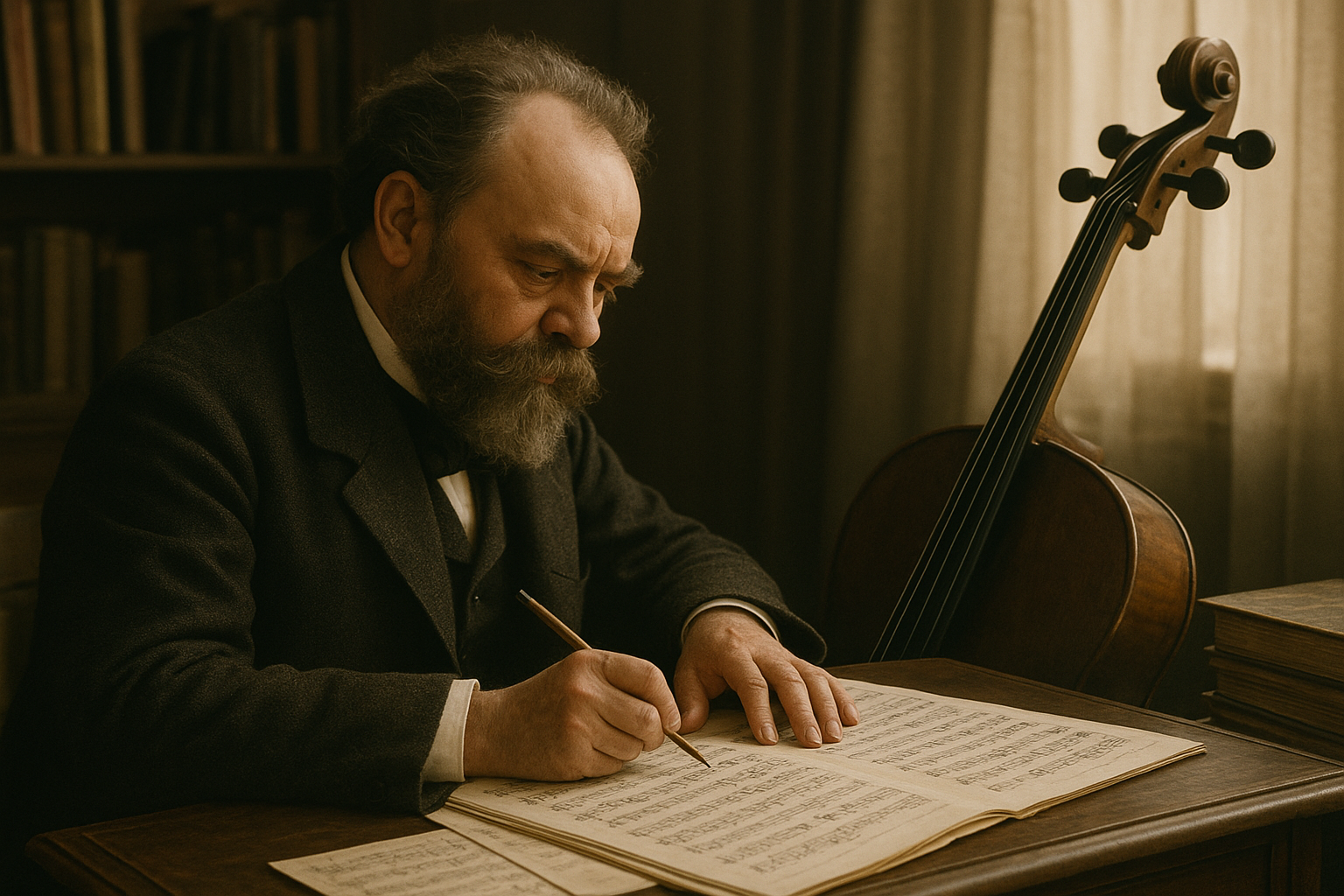
The Genesis of the G Major Cello Concerto: Dvořák’s Creative Process
Antonín Dvořák, one of the most celebrated composers of the Romantic era, is renowned for his profound impact on the world of classical music. His Cello Concerto in B Minor, Op. 104, remains a staple in the repertoire of cellists worldwide. However, less is known about his earlier and now lesser-known G Major Cello Concerto, a work that offers unique insight into his creative process.
The Initial Spark
The genesis of Dvořák’s G Major Cello Concerto dates back to the 1860s—a period of significant personal growth and professional exploration for the composer. It is believed that his deep admiration for renowned cellist David Popper may have influenced his interest in writing for the cello. At this time, Dvořák was steadily gaining recognition, and he was experimenting with various musical forms and instrumentation. The G Major concerto was one of these early attempts, showcasing his developing style.
- Composed between 1865-1867, this concerto was a reflection of Dvořák’s early forays into orchestral music.
- The work remained unpublished and largely unknown during his lifetime.
- Dvořák revisited the genre later with his more famous Cello Concerto in B Minor, which overshadowed earlier efforts.
The Creative Process
Dvořák’s work on the G Major Cello Concerto involved an intricate creative process marked by both intuition and technical skill. According to musicologist John Clapham, Dvořák’s initial concepts for his compositions often began with a simple, singable theme that would then be elaborated through various instrumental textures.
“Dvořák’s themes tended to be folk-like in character, reflecting his Bohemian heritage, yet they were also infused with a universality that made them accessible to audiences worldwide.” — Encyclopedia Britannica
In the case of the G Major concerto, one can perceive the budding ideas that would later flourish in his more mature works:
- The melodic structure is noticeably simpler than in his later compositions, emphasizing clarity and thematic repetition.
- The orchestration shows Dvořák’s early attempts at creating a rich, dynamic interplay between the solo cello and the orchestra.
- The harmonic progressions reflect both traditional elements and Dvořák’s inherent inclination towards innovative modulations.
Challenges and Discoveries
Dvořák faced numerous challenges during this period, primarily concerning his confidence in orchestrating for the cello. Not originally a cellist himself, he had to navigate the instrument’s unique demands and temperamental response in conjunction with an orchestra. It was through trial and error in the G Major concerto that Dvořák honed this skill, which became prominent in his later works.
Interestingly, the concerto was never performed publicly during Dvořák’s lifetime, and the manuscript seemingly disappeared into obscurity until it was rediscovered in the late 20th century. This rediscovery has sparked renewed interest and scholarly discussion on the concerto’s role in Dvořák’s development as a composer.
Legacy and Appreciation
While the G Major Cello Concerto does not share the fame of its successor, it stands as a testament to Dvořák’s early ingenuity and dedication to mastering the form. Its completion marked a significant step towards the refined and emotionally resonant Cello Concerto in B Minor. The latter work, composed in 1895, came to be seen as a quintessential piece of the cello repertoire, celebrated for its expressive depth and intricate orchestration.
Today, musicians and scholars harken back to the G Major concerto as a significant milestone in understanding Dvořák’s artistic journey. It underscores the composer’s progressive evolution from a budding artist experimenting with musical ideas to a mature master craftsman capable of producing works of remarkable beauty and complexity.
Conclusion
The tale of the G Major Cello Concerto is not merely a story of an early draft overshadowed by later achievements. Rather, it’s an essential chapter in the narrative of Antonín Dvořák’s quest to find his unique voice in the world of classical music. As we continue to rediscover and appreciate such works, we gain a deeper understanding of the artistic processes that shape the masterpieces we cherish today.