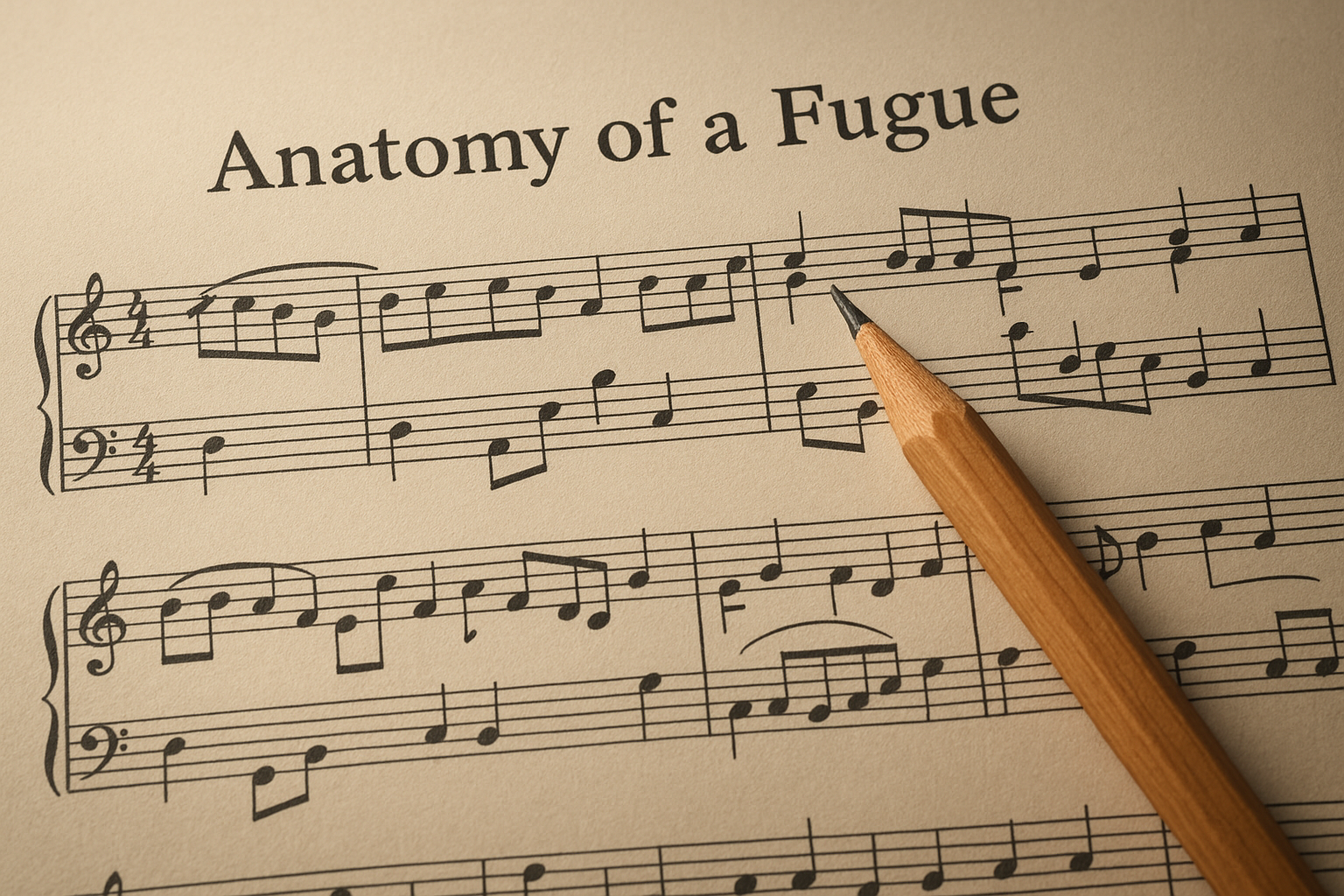
Anatomy of a Fugue: In-Depth Analysis of Bach’s Well-Tempered Clavier
The Well-Tempered Clavier by Johann Sebastian Bach stands as one of the masterpieces of Western music, a quintessential work that has influenced generations of composers and musicians. Comprising two books of preludes and fugues in all 24 major and minor keys, it is revered not only for its technical mastery but also for its expressive depth and complexity.
Understanding the Fugue
A fugue is a polyphonic composition based on a central theme, called the “subject,” that is introduced at the beginning and developed in interweaving melodic lines, or “voices,” throughout the piece. Bach’s fugues display the intricate balance between order and creativity, demonstrating his unparalleled command over counterpoint.
- Subject: The central theme upon which the fugue is based. In the Well-Tempered Clavier, these subjects range from simple motifs to complex melodic fragments.
- Answer: The second entry of the subject, typically transposed to a different key, often the dominant.
- Episode: Passages of connective material that offer contrast and development, usually excluding the complete subject.
- Stretto: Overlapping entries of the subject that heighten tension and complexity.
- Countersubject: A secondary theme that accompanies the subject or answer, adding further layers to the texture.
In the Well-Tempered Clavier, each fugue is tailored to the emotional and technical characteristics of its key, demonstrating Bach’s genius in blending harmony and counterpoint.
The Historical Context
Composed during the early 18th century, Bach’s Well-Tempered Clavier played a crucial role in the evolution of Western classical music. The well-tempered tuning system allowed for writing in all keys without unpleasant intonation issues that plagued earlier tuning systems.
“The purpose of the Well-Tempered Clavier was not only to explore the possibilities of this new tuning system but also to provide a comprehensive teaching tool for musicians. It offered insights into the tonal possibilities of keyboard music, shifting the paradigm of compositional and performance practices.” — Encyclopedia Britannica
In-Depth Analysis of Selected Fugues
Fugue in C Major, BWV 846
Opening the first book of The Well-Tempered Clavier, the C major fugue is characterized by its clarity and brightness. The subject, comprising a mix of leaps and stepwise motion, establishes a firm tonal center. The ensuing voices enter successively, each subtly intertwining with the others. The fugue’s simplicity belies its elegant structure and the precision required to bring out its beauty.
Fugue in C Minor, BWV 847
The C minor fugue showcases Bach’s ability to imbue music with emotional weight. Here, the subject is more rhythmic and insists upon its melodic pathway. As this fugue unfolds, Bach employs episodes with dramatic harmonic shifts and stretto passages, creating tension and resolution in a vivid musical journey.
Fugue in D# Minor, BWV 853
Considered one of the most complex fugues in Book I, the D# minor fugue is a testament to Bach’s mastery. The angular melody of the subject and its dense contrapuntal texture demand virtuosic control. Throughout, Bach expertly weaves the countersubjects, creating an intricate tapestry of sound with moments of striking dissonance and resolution.
The Legacy of Bach’s Fugue Writing
The Well-Tempered Clavier has resonated through the centuries, influencing composers like Mozart, Beethoven, and Chopin. Its blend of intellectual rigor and emotional expressivity set a standard for musical composition, earning its place as an essential study for anyone passionate about classical music.
“Bach’s music is remarkable for its technical brilliance and profound beauty, remaining a cornerstone of the keyboard repertoire and a testing ground for any serious musician.” — BBC Music Magazine
In conclusion, the Well-Tempered Clavier epitomizes Bach’s vision of music as a divine language. Each fugue within its pages offers a world of its own, inviting performers and listeners alike to explore the intricate dialogue between structure and freedom.