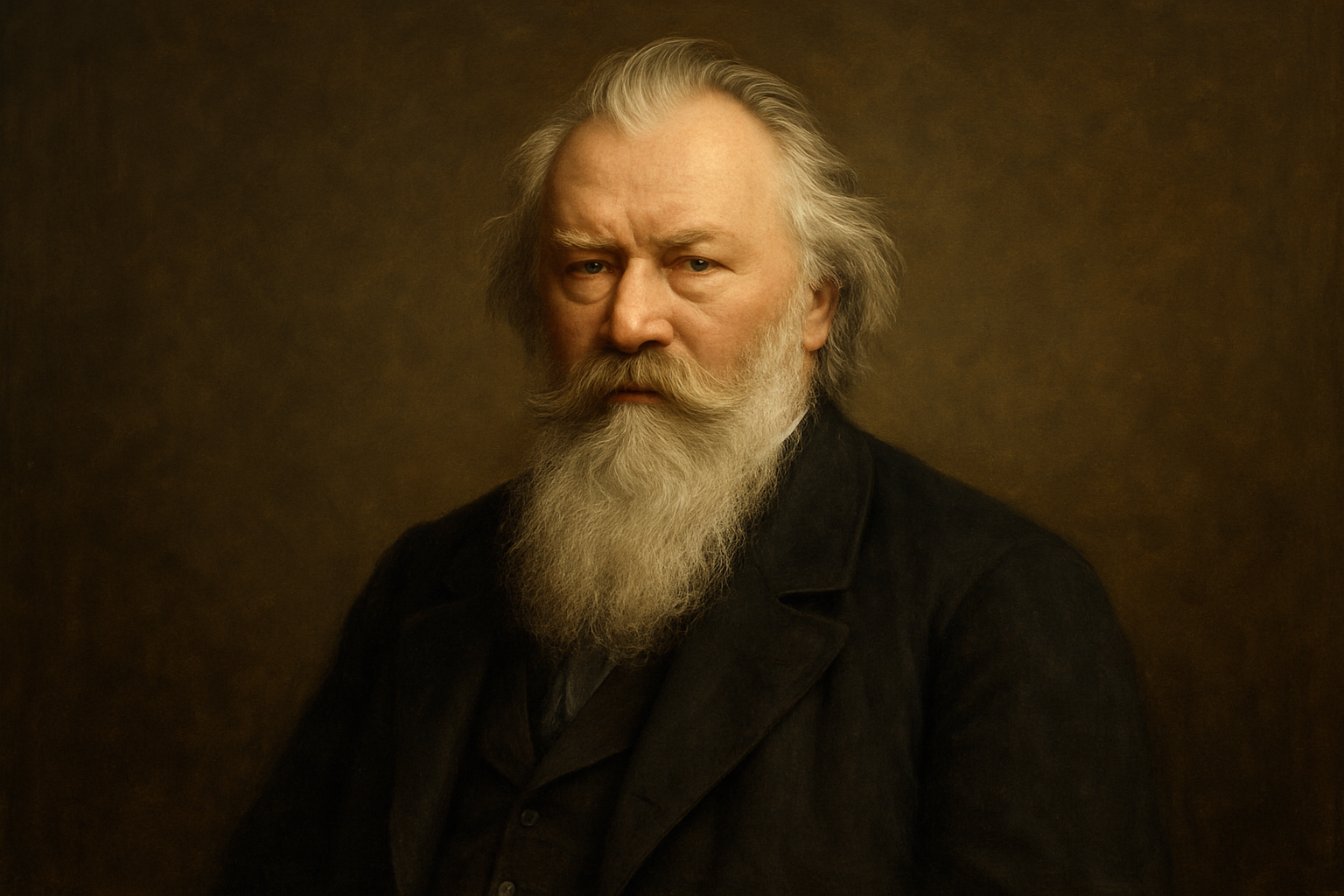
Johannes Brahms, one of the towering figures of the Romantic period, seamlessly bridges the gap between the Classical tradition of Beethoven and the full-blooded Romanticism that characterized much of the 19th century. Often viewed as Beethoven’s successor, Brahms was hailed as the master of “absolute music,” a term used to describe music not explicitly about anything, in contrast to program music.
The Early Years and Musical Development
Born on May 7, 1833, in Hamburg, Brahms was the son of a musician. His father, Johann Jakob Brahms, was a double bassist, which exposed young Johannes to a musical environment from an early age. At seven, he began to study piano, showing exceptional talent that would soon propel him to the forefront of the European musical scene.
“Without craftsmanship, inspiration is a mere reed shaken in the wind,” Brahms is quoted as saying, emphasizing his dedication to musical technique and formal mastery. Source: Goodreads
The Influence of Beethoven
Brahms’s relationship with Beethoven was complex. He adored Beethoven’s music and aspired to uphold the high artistic standards set by the composer. Beethoven’s influence is particularly evident in Brahms’s symphonic works, where he combined the traditional structures and forms with Romantic expressiveness.
In 1853, Robert Schumann, a leading composer and critic of the time, wrote a famous article in Neue Zeitschrift für Musik, proclaiming Brahms as the future hope of German music. In this piece, Schumann enthusiastically declared:
“He [Brahms] has come, a young man over whose cradle graces had presided and with whose baptism good spirits had joined; he is called Johannes Brahms.” Source: The Archives Hub
Brahms’s Absolute Music
Unlike many of his contemporaries, Brahms eschewed programmatic elements in favor of “absolute music,” which stands on its own without recourse to extramusical themes or stories. His music is characterized by formal perfection, a clear structure, and a focus on the internal logic of the music itself.
- Symphonies: Brahms wrote four symphonies, each a masterpiece of thematic development and orchestration. His first symphony, in C minor, was famously described by the conductor Hans von Bülow as “Beethoven’s Tenth” due to its allusions to Beethoven’s work.
- Piano Works: His Piano Concertos, particularly the second, are prime examples of blending virtuosic capabilities with deep musical substance.
- Chamber Music: Illustrating exquisite intimacy, Brahms’s chamber works explore a wide range of emotions and textures, from the gypsy-influenced Piano Quartet No. 1 to the magisterial Clarinet Quintet.
- Choral Works: His German Requiem, based on biblical texts, stands out as a monumental choral work.
The Legacy of Brahms
Brahms’s influence on later composers cannot be overestimated. His adherence to form and structural clarity laid the groundwork for composers such as Arnold Schoenberg, who saw Brahms as a progressive despite his traditional approach. Schoenberg even wrote an influential essay titled Brahms the Progressive, arguing that Brahms’s use of developing variation and counterpoint was forward-thinking.
In his article, Schoenberg famously stated:
“Brahms’s compositions are similar to Bach’s in that they reveal the beauty of their elements only at second, third, or fourth hearing.” Source: Classic FM
Brahms’s Place in the Pantheon of Music
Even today, Brahms’s music continues to captivate audiences with its intricate balance of emotion and intellect. His works are staples in concert halls worldwide, beloved for their depth and beauty. The influence he exerted speaks to his lasting place as both an heir to Beethoven and a pillar of the classical music tradition.
It is impossible to overstate the importance of Brahms’s contributions to music. His works, embodying the highest aspirations of human creativity, ensure that Brahms will always be remembered as one of the greatest composers in history.
As we continue to explore the richness of the classical music canon, the genius of Brahms endures, inspiring both musicians and audiences alike to appreciate music’s power to transcend the temporal.