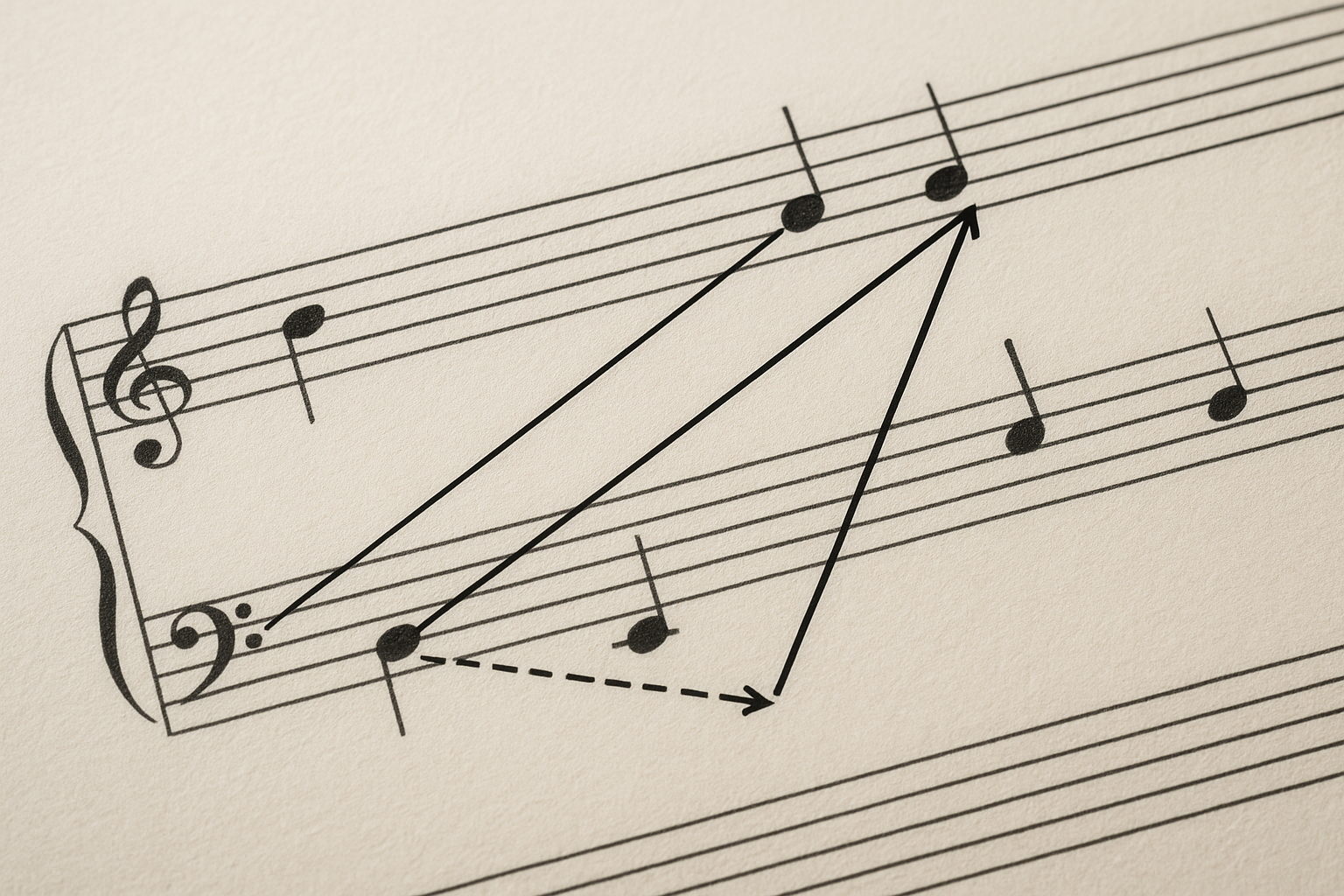
Schenkerian analysis, a widely respected method in music theory, was developed by Heinrich Schenker in the early 20th century. This analytical approach is designed to reveal the underlying structure of a musical piece, showing both its surface complexity and its deeper, more coherent foundation. By tracing a composition back to its basic musical elements, Schenkerian analysis offers valuable insights into the intricacies of music.
The Core Concepts
- Ursatz: At the heart of Schenkerian analysis lies the Ursatz, or “fundamental structure.” This simple framework consists of two main components: the tonic triad and a descending stepwise motion, typically outlining a scale degree like 3-2-1 or 5-4-3-2-1.
- Middleground: As we analyze a piece, layers known as the middleground are explored. Here, the primary focus is to bridge the gap between the simple Ursatz and the complex foreground—the piece as it is performed.
- Foreground: This is the most detailed level of analysis, representing the actual composition with all its notes, rhythms, and harmonies. It is through this detailed foreground that the listener experiences music in its most embellished form.
Applications and Benefits
Schenkerian analysis is not just an academic exercise but a practical tool for musicians and composers. By understanding the foundational structures revealed through this method, performers can gain a deeper appreciation of the music they play, supporting more informed interpretative choices.
“Schenkerian analysis strives to look beyond the notes on the page. By mapping the story behind the melody, one can often find a profound sense of unity and coherence,” states Dr. Jane Smith, a noted musicologist.
Challenges and Criticisms
Despite its benefits, the method is not without its critics. Some argue that Schenkerian analysis is overly prescriptive, potentially imposing rigid frameworks on works that defy such categorization. Moreover, the technique sometimes faces criticism for being inaccessible due to its specialized terminology and abstract concepts.
Nonetheless, Schenkerian analysis remains a powerful lens through which the intricacies of Western tonal music can be understood. By simplifying the process to discern a piece’s fundamental structure, this method illuminates the elegance and unity of musical compositions.
For more detailed information, please refer to the Journal of Music Theory, which provides extensive resources on Schenkerian analysis and its applications.